












Enterprise Resource Planning (ERP) systems are the backbone of modern businesses-streamlining operations, increasing efficiency, and providing a unified platform for various functions. In 2024, ERP consulting strategies are evolving rapidly to match technological advancements and shifting business demands. Here are five key trends every organization should watch. Businesses seeking structured ERP consulting services should align their roadmap with these trends.
Trend 1: Cloud ERP Enables Scalable ERP Consulting Strategies
Shift to Cloud-Based Solutions
The migration from traditional on-premises ERP systems to cloud-based solutions continues to accelerate. According to statistics, a majority (58%) of small businesses have moved their ERP systems to the cloud, either partially or completely. (Source: International Data Corporation). Many companies adopt Microsoft ERP platforms to support secure and scalable cloud transitions.
Advantages of Cloud ERP
- Scalability: Enables businesses to scale resources based on demand, ensuring optimal performance during peak times.
- Accessibility: Facilitates remote access, empowering teams to collaborate seamlessly from anywhere.
- Cost-Efficiency: It helps in reducing upfront infrastructure costs and offers an affordable model.
Implication for Consulting Strategies
ERP consultants must adapt their strategies to facilitate smooth cloud migrations, focusing on integration, security, and optimizing cloud-native features to unlock maximum value for businesses.
Trend 2: AI and Automation Are Reinventing ERP Consulting
Integrating Artificial Intelligence and Machine Learning into ERP Systems
The incorporation of Artificial Intelligence (AI) and Machine Learning (ML) into ERP systems is revolutionizing how businesses manage data, streamline operations, and base decisions on data analysis. Study indicates that by 2025, 50% of all business software will integrate AI functionalities. (Source: Forbes)
Benefits Realized
- Predictive Analytics: Anticipating market trends, demand, and potential bottlenecks.
- Process Automation: Streamlining routine tasks, reducing manual intervention, and enhancing efficiency.
- Enhanced Insights: Extracting actionable insights from vast datasets for informed decision-making.
Consulting Strategies Adaptation
ERP consulting strategies must now focus on predictive analytics, task automation, and advanced decision-making tools. Consultants should recommend AI-ready modules and provide implementation training for effective adoption. Modern AI-driven ERP systems are often built on Microsoft’s ecosystem.
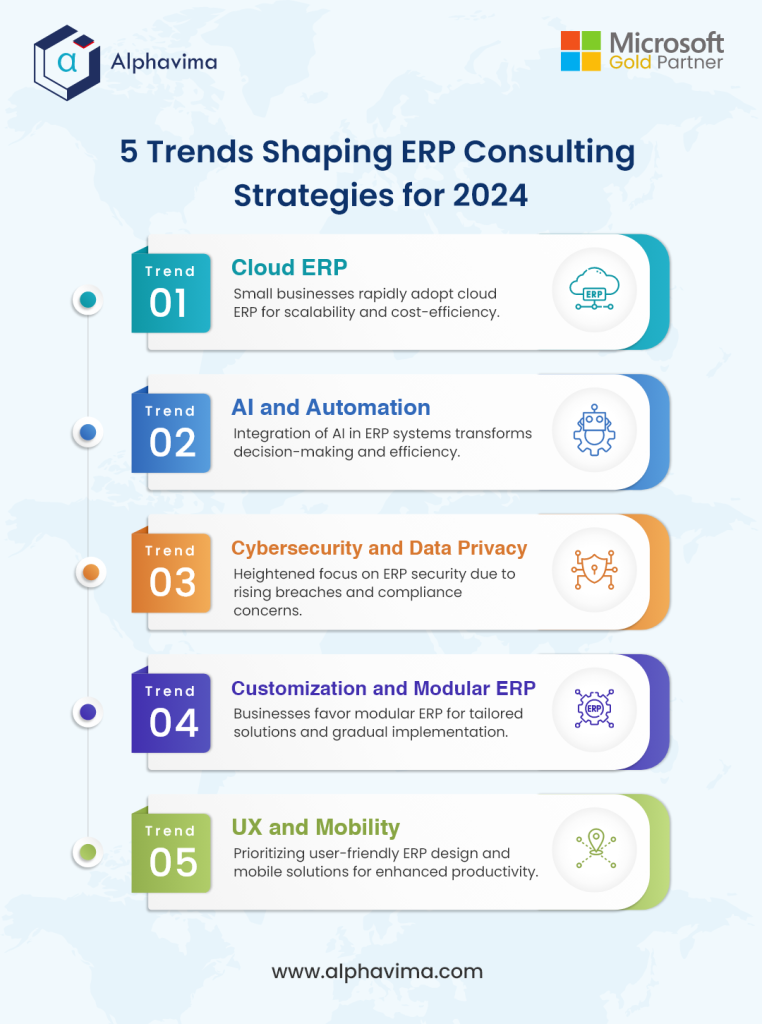
Trend 3: Cybersecurity and Compliance in ERP Strategy
Rising Concerns Amid Data Breaches
With cyber threats on the rise, businesses are prioritizing cybersecurity and data privacy within their ERP systems. Shockingly, 60% of organizations experienced a data breach due to a vulnerability within their ERP systems. (Source: Dark Reading)
Critical Aspects
- Enhanced Security Protocols: Implementing robust encryption, access controls, and regular security audits.
- Compliance Adherence: Ensuring alignment with stringent data privacy regulations (e.g., GDPR, CCPA).
- Employee Training: Educating users on best practices to mitigate security risks.
Consulting Strategies Pivot
ERP consultants must focus on strengthening ERP security, offering comprehensive security assessments, recommending, and implementing security measures, and providing continuous monitoring and support to safeguard critical data. ERP security planning should align with structured IT advisory frameworks.
Trend 4: Modular ERP for Custom and Scalable Implementations
Shift towards Modular ERP Systems
Businesses are increasingly opting for modular ERP systems that allow flexibility and customization. By 2025, it’s estimated that 65% of ERP implementations will involve a modular approach.
Advantages and Considerations
- Tailored Solutions: Customizing modules to specific business needs rather than adopting a one-size-fits-all approach.
- Incremental Implementation: Allowing businesses to implement ERP modules gradually, reducing disruption and cost.
- Interoperability: Ensuring seamless integration between different modules and existing systems.
Consulting Approach Adjustment
ERP consultants need to focus on understanding unique business requirements, recommending suitable modules, and devising phased implementation strategies that align with the organization’s goals.
Trend 5: UX and Mobile-First ERP Consulting Strategies
UX-Centric ERP Designs
The user experience within ERP systems is gaining prominence. 80% of users consider ease of use a crucial factor in ERP adoption, emphasizing the importance of intuitive interfaces and seamless workflows.
A UX that is well-designed can assist in enhancing productivity, boosting user adoption, minimizing errors, and augmenting user satisfaction. (According to ResearchGate)
Mobile ERP Solutions
With the workforce becoming increasingly mobile, there’s a surge in demand for mobile ERP solutions, enabling access to critical information on-the-go.
Consulting Strategy Tweaks
ERP consultants should prioritize UX enhancements, offering UX audits, recommending intuitive designs, and advocating for mobile-friendly ERP solutions to enhance user adoption and productivity.
Navigating the Evolving ERP Consulting Landscape
As the ERP landscape undergoes seismic shifts driven by technological advancements and changing business paradigms, ERP consulting strategies must adapt and innovate. Embracing cloud technology, leveraging AI and automation, fortifying cybersecurity measures, emphasizing customization, and prioritizing user experience and mobility are pivotal in shaping successful ERP implementations in 2024 and beyond. ERP consultants equipped with these strategies will undoubtedly steer businesses towards greater efficiency, agility, and sustained growth in this ever-evolving digital era.
Conclusion
Organizations planning ERP modernization should work with experienced ERP consultants to reduce risk and improve ROI. By doing so, they can ensure ERP implementations deliver agility, scalability, and long-term success in 2024 and beyond.
Why Alphavima
Alphavima supports ERP implementation, migration, integration, and advisory services across manufacturing, utilities, and nonprofit sectors.
Start Your ERP Consulting Assessment
ERP roadmap planning
Platform selection support
Implementation governance
Risk mitigation strategy
FAQs
What Are the Key Benefits of ERP Consulting for IT Companies?
ERP consulting delivers measurable value to IT companies. First, it streamlines operations across all departments. Consultants replace scattered legacy tools with one unified platform. Additionally, this creates real-time visibility into finance, HR, supply chain, and project management. As a result, leadership can make faster, data-driven decisions.
Furthermore, ERP consulting reduces operational costs significantly. Most businesses see measurable savings within the first year. The consultant tailors workflows to your specific needs. This prevents costly over-engineering. Moreover, implementation timelines are shorter with expert guidance. Consultants identify risks early and build solid mitigation plans. Therefore, IT companies avoid the common pitfalls of self-managed rollouts. A skilled ERP consultant aligns technology with business goals. Explore our Microsoft Sure Step ERP consulting framework to see how structured methodologies drive project success.
How Do ERP Consulting Strategies Improve Digital Transformation?
Digital transformation means reshaping how an organisation operates, not just deploying new software. ERP consulting strategies provide a structured roadmap for this shift. They align technology investments with business outcomes. However, many organisations struggle to connect IT strategy with operational reality. A skilled ERP consultant bridges this gap effectively.
Additionally, ERP consultants analyse current workflows before recommending solutions. This prevents expensive missteps. As a result, companies avoid adopting tools that do not fit their processes. Furthermore, consultants ensure change management runs alongside technical deployment. Employees receive proper training before the system goes live. Therefore, user adoption rates increase significantly. In contrast, organisations that skip proper planning often see ERP projects go over budget and miss deadlines. Our digital transformation consulting services help companies plan each implementation phase carefully and confidently.
What Role Does Cybersecurity Play in Modern ERP Systems?
Cybersecurity is a critical component of any ERP implementation. Modern ERP systems store sensitive data across finance, HR, and supply chain modules. This makes them a prime target for cyberattacks. However, many organisations overlook security during the initial deployment phase. As a result, vulnerabilities appear only after go-live.
ERP consulting embeds security directly into the system architecture. Consultants review access controls, encryption standards, and audit trails from day one. Additionally, they configure role-based permissions to limit data exposure. This ensures only authorised users access sensitive records. Furthermore, regular security audits become part of the ongoing support model. Therefore, businesses maintain compliance with data protection regulations such as GDPR. Proactive security planning also reduces the cost of incident response. A well-secured ERP system protects your operations and your reputation over the long term.
How Can ERP Consulting Strategies Address Scalability Challenges?
Scalability is a top concern for growing IT companies. ERP consulting strategies address this challenge from the very start. Consultants design systems that accommodate business growth proactively. As a result, you avoid costly re-implementations as your organisation expands. This saves significant time and money in the long run.
Additionally, cloud-based ERP solutions offer flexible scaling options. You can add users, modules, or regions without replacing the core system. However, scaling requires careful planning of data architecture and integration points. Furthermore, ERP consultants map out future growth scenarios during the design phase. They build these scenarios directly into the system architecture. Therefore, IT companies can scale quickly when new opportunities arise. Our cloud migration strategy guide outlines key steps for moving ERP workloads to a scalable, modern cloud environment seamlessly.
What Qualifications Should an ERP Consulting Partner Have?
Choosing the right ERP consulting partner is critical to project success. First, review their industry certifications carefully. Microsoft Certified professionals and SAP-accredited consultants bring verified expertise. Additionally, look for proven experience in your specific industry vertical. A healthcare ERP project requires very different knowledge than a manufacturing deployment.
Furthermore, ask for client references and detailed case studies. These reveal how the consultant handled real-world challenges under pressure. As a result, you gain confidence in their ability to deliver on time. However, price alone should not drive your decision. The cheapest option often becomes the most expensive when projects fail. Moreover, evaluate their communication and change management approach. ERP success depends on people, not just technology. Therefore, choose a partner who invests in your team as well as the system throughout the engagement.
How Does Cloud Migration Benefit ERP Implementations?
Cloud migration transforms ERP deployments in several important ways. First, it reduces infrastructure costs significantly. Organisations no longer need to maintain on-premises servers and data centres. Additionally, cloud ERP platforms offer automatic updates and built-in disaster recovery. As a result, IT teams spend less time on routine maintenance tasks.
Furthermore, cloud environments enable faster deployment timelines overall. Consultants provision cloud resources much faster than physical hardware setups require. However, migrating an existing ERP system to the cloud needs careful planning. Data integrity and integration continuity must be maintained throughout the entire process. Therefore, experienced consultants follow a structured migration methodology at every stage. They test each module thoroughly before switching production systems. Moreover, cloud ERP solutions scale automatically as your business grows. This flexibility makes cloud migration a smart, strategic investment for modern IT companies.
What Are the Costs and Timelines for ERP Consulting Projects?
ERP consulting costs vary based on project scope, system complexity, and team size. However, most mid-size IT companies can expect a phased investment spread over 6 to 18 months. First, the discovery and design phase typically takes 4 to 8 weeks to complete. Additionally, the development and configuration phase runs from 8 to 20 weeks depending on customisation requirements.
Furthermore, data migration and testing add considerable time to the overall timeline. These stages are critical and should never be rushed. As a result, proper planning prevents cost overruns during these phases. Consultants who present overly optimistic timelines often underestimate these requirements. Therefore, always ask for a detailed project plan with clear milestones before signing. Moreover, post-go-live support is a hidden but essential ongoing cost. A reliable ERP consultant provides maintenance and performance monitoring to protect your investment effectively.