












Business Objective:
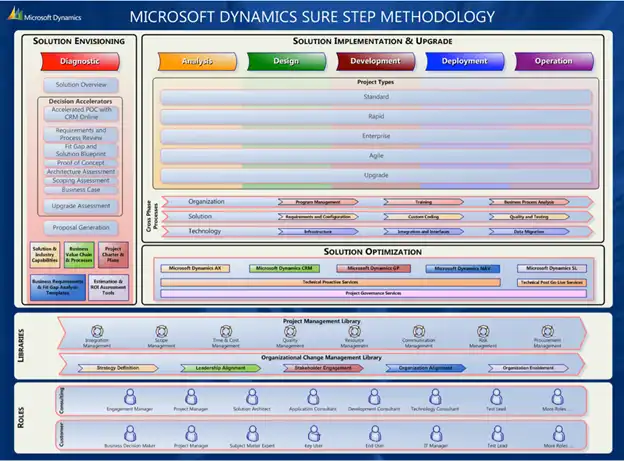
Every CRM software needs implementation/deployment best practices that reduce risk and cost, help focus on core competencies, and increase profits and customer satisfaction. That’s where Sure step comes into picture as a structured implementation methodology to help organizations address some of the above key challenges.
Microsoft Sure Step is a structured methodology developed by Microsoft to guide the implementation of ERP and CRM solutions such as Dynamics 365. According to Microsoft Learn, selecting the right implementation strategy is crucial for aligning project scope, business needs, and delivery expectations.
Introduction:
Sure Step is the official Software Process from Microsoft for Dynamics Projects. Like any other Software Process, Sure Step tells you WHO shall do WHAT in WHICH ORDER and who is RESPONSIBLE for what. So, a software process can be seen as the sum of years of knowledge and best practice in software development. Sure Step defines process phases, milestones roles, artefacts, cross-phase-processes and additional project management processes. Sure Step supports a broad range of products: Dynamics AX, Dynamics NAV, Dynamics GP, Dynamics SL, and Microsoft Dynamics CRM software. And different project types: Full Implementation, Rapid Implementation, Optimization and Upgrade. Products and project types can be combined.
Talk to an ERP consultant
Book a quick call to talk through your ERP project. No pressure, just practical advice. Or see our ERP consulting services.
Why Is Sure Step Needed:
The key success with any software solution is how the solution is implemented and how the implementation is managed. Explore Technology Transformation Services to streamline ERP and CRM rollouts. With this as a back-ground Microsoft has developed Sure Step as the full life cycle methodology for Microsoft Dynamics Solution Portfolio.
Reasons for Failure of Solution Implementation:-Rigid Organization ProcessUnmanaged Project ExecutionLack of traceabilityNon documented activitiesLack of Formal Acceptance from Clients on our understanding.
Types of Projects:
> Standard Project: Is a lean approach for Implementing Dynamics Solution at a single stage.
> Rapid Project: Accelerated approach for implementation with minimal or no customizations.
> Enterprise Project: Standardized approach for implementing dynamics solutions in complex single site deployments or in global/multi site organization where in country specific unique business needs have to be factored on top of core solution.
> Agile Project: Iterative approach to implementation at a single site requiring specific features and moderate to complex customizations. It uses sprint cycle approach while other project types use waterfall approach.
> Upgrade Project: describes the approach to an existing solution to a subsequent release of that solution. This approach starts with a technical upgrade to address moving existing functionality to the subsequent release.
Purpose and Key Deliverable:
The Sure Step methodology outlines six distinct phases-Diagnostic, Analysis, Design, Development, Deployment, and Operation. Mercurius IT provides a detailed breakdown of these stages, emphasizing structured templates, milestones, and best practices for each phase. Additionally, Elian Solutions highlights how these phases mitigate risk and improve delivery consistency.
> Diagnostic – To help the customer determine the right solution to meet their needs and obtain a key understanding of the solution requirements. Diagnostic Offering helps pre sales team to understand and explain business requirement and mapping of customer.
> Analysis – The analysis phase defines the activities required to initiate and effectively plan the entire project.
> Design – The design phase includes configuration of the overall Microsoft Dynamics solution and the design of specific customizations needed to satisfy business requirements. If your organization requires specific integrations, consider Custom CRM Development.
> Development – The goal of the development phase is to build and test the system components defined and approved in the design specifications, including developing the customizations, integrations and interfaces and data migration processes.
> Deployment – The deployment phase is where all the efforts of the project team come together for a successful transition to the new Microsoft Dynamics solution. Improve your CRM and ERP workflows with Power Platform Services. Key activities in this phase include End User Training, User Acceptance Testing and the actual cutover to the new or upgraded production environment.
> Operation – The Operation phase defines the activities required to close the project, provide post-production support and transition the solution and knowledge to the customer.
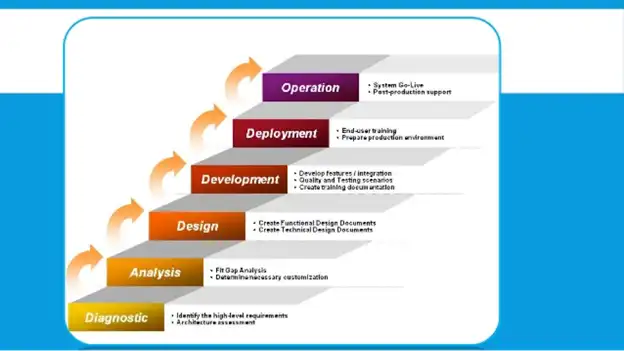
Each stage shall be described using the following 3 points – Objective, Deliverable and their Milestones. These points shall be identified by the organization.
Analysis:
Objectives:
> Finalization and approval of project charter and project plan
> Execution of project kickoff meeting
> Documentation and approval of functional requirements
Deliverables:
> Project charter and plan
> FRD
> Gap analysis
> User training requirements
> Workflows
> Environment specification
> Data migration requirements
Milestones:
> Formal Project Kickoff meeting
> Customer Approval of Project charter and plan
> Customer approval of FRD and Gap analysis
> Infrastructure and environment definitions
Design:
Objectives:
> Goal to define how Business requirements will be implemented
> Design for Customization
> Identify the integration points
Deliverables:
> Functional Design Document
> Solution Design document
> Technical design document
> Core team training at customer side
Milestones:
> Customer acceptance of design specifications
> Customer approves dev time and cost estimates
Development:
Objectives:
> Customization Development
> Development of major deliverables
> Other Key objectives like solution testing to be complete
Deliverables:
> Final system configuration
> Final custom code development
> Solution testing
> UAT scripts
> Final production environment specifications
> Final data migration
Milestones:
> ISV solution upgrade complete
> Customization code upgrade complete
> Integration with other interfaces complete
> Solution testing complete
> UAT script confirmation
> Customer signoff for production environment technical architecture
Deployment:
Objectives:
> Getting ready for customer delivery and Go Live
Deliverables:
> End user training
> UAT test results
> Final Data Migration
> Final Go Live checklist
Milestones:
> End user training complete
> UAT complete
> Final data migration complete
> Production environment ready
> System Go Live
Operation:
Objectives:
> Close the Project
> Provide post production support
> Transition the solution and knowledge to the customer
Deliverables:
> Project Closure Report
> Final delivery of the project to the customer
> Documented lessons learned
Milestones:
> Post go live support complete
> Transition of solution to support complete
> Formal Project closure
> System acceptance and sign off
Microsoft Dynamics Sure Step Methodology:
Faster implementation time – The Sure Step model provides tools, templates and best practices which cover all aspects of projects to increase consistency, timeframes, quality and success of projects.
Repeatable model – Sure Step is a flexible and repeatable model which can fit any business or project type, this assures customers you’re using the same consistent approach and following the correct procedures during a Dynamics integration.
Increased customer satisfaction – Sure Step allows for a faster project completion with minimal risk and a lower total cost of ownership (TCO), which can all lead to increased customer satisfaction. Enhance your ERP analytics with Business Analytics Solutions.
Resources – Microsoft Dynamics Sure Step Methodology provides a standard set of tools and templates which can be used to guide through the implementation process and help ensure customers’ projects are completed efficiently. The methodology can be applied to projects of any size and in any industry, as well as working with multiple project types, helping fit unique business requirements.
Conclusion
For decision-makers, the ERP Software Blog highlights how the Microsoft Sure Step methodology aligns technical execution with business objectives through structured, milestone-based tracking. Additionally, Integris emphasizes that organizations leveraging Sure Step often achieve higher implementation success rates and reduced total cost of ownership.
Looking to implement ERP or CRM with a proven approach?
Use the Microsoft Sure Step framework with Alphavima to plan, deploy, and manage your ERP or CRM projects effectively.

Related case study
Manufacturing ERP on Business Central
A manufacturer put the shop floor, stockroom and finance on one Dynamics 365 Business Central ERP.
Read the case study · Next read: The 12-question ERP selection checklist
FAQs
What Is the Microsoft Sure Step Methodology and How Does It Work?
The Microsoft Sure Step Methodology is a proven implementation framework for Dynamics projects. It provides consultants and clients with a structured delivery model. First, it defines clear phases and milestones for every project. Additionally, it standardises documentation, roles, and decision checkpoints. As a result, projects stay on track and within scope.
Furthermore, Microsoft Sure Step reduces implementation risk significantly. Consultants follow a repeatable process instead of starting from scratch each time. However, it is not a rigid checklist. It adapts to the specific needs of each organisation and project type. Therefore, teams can apply it to ERP, CRM, and cloud deployments alike. A structured framework like this improves client satisfaction and project outcomes. Our ERP consulting strategies guide explains how this methodology fits into a broader implementation approach.
Is This Framework Suitable for Both On-Premise and Cloud Dynamics Deployments?
Yes, Microsoft Sure Step works for both on-premise and cloud Dynamics deployments. However, the application differs slightly between the two. On-premise projects require more infrastructure planning and hardware provisioning steps. Cloud deployments, on the other hand, focus more on tenant configuration and integration setup.
Additionally, cloud projects benefit from faster initial provisioning. As a result, teams can move into configuration and testing sooner. Furthermore, Microsoft Sure Step adapts its documentation templates to match each deployment type. Therefore, consultants follow the same core methodology regardless of the infrastructure choice. Moreover, many organisations run hybrid environments combining cloud and on-premise systems. This framework handles both scenarios within a single cohesive project plan. It provides flexibility without sacrificing structure or predictability throughout the engagement.
Why Does a Structured Implementation Framework Matter for ERP and CRM Projects?
Structured implementation frameworks reduce project failure rates significantly. ERP and CRM projects are complex by nature. They involve multiple teams, departments, and technical dependencies. Without a clear methodology, projects often go over budget and miss deadlines. However, a proven framework prevents this from happening.
Additionally, structured frameworks improve communication between consultants and clients. Everyone understands their roles and responsibilities from day one. As a result, there are fewer misunderstandings and unexpected delays. Furthermore, frameworks enforce quality control at each phase. Therefore, issues are caught early before they become costly problems. Moreover, clients feel more confident when consultants follow a recognisable methodology. Our Dynamics migration services use structured frameworks to ensure every transition stays on schedule and on budget.
What Are the Six Phases of the Microsoft Sure Step Methodology?
Microsoft Sure Step defines six structured phases for Dynamics implementations. First comes the Diagnostic phase, where consultants assess business requirements and scope the project. Second is the Analysis phase, which documents detailed functional and technical specifications. Third, the Design phase maps solution components to business requirements clearly.
Fourth is the Development phase, where customisations and configurations are built and tested. Fifth comes the Deployment phase, covering user training, data migration, and go-live preparation. Finally, the Operation phase provides post-go-live support and performance monitoring. Additionally, each phase produces specific deliverables that serve as project milestones. As a result, clients always know exactly where their project stands. Furthermore, this phased structure makes it easy to manage change requests without derailing the overall timeline.
How Does This Approach Handle Both Cloud and On-Premise Scenarios Differently?
The core methodology remains consistent for both deployment types. However, Microsoft Sure Step adjusts specific activities based on the infrastructure environment. Cloud deployments skip many hardware-related tasks. Instead, they focus on tenant provisioning, licence configuration, and integration with Microsoft 365 services.
Additionally, on-premise deployments require server sizing, network configuration, and security hardening steps. As a result, the Diagnostic and Design phases take slightly longer for on-premise projects. Furthermore, data migration approaches differ between the two environments. Cloud environments often use pre-built migration tools, while on-premise migrations require more custom scripting. Therefore, consultants plan these activities separately within the same framework structure. Moreover, hybrid deployments need additional integration planning to ensure both environments communicate reliably and securely.
Which Types of Dynamics Projects Benefit Most from This Framework?
Microsoft Sure Step delivers the greatest benefit on large, complex Dynamics implementations. First, multi-module Dynamics 365 deployments benefit from the structured phase-gate approach. Additionally, projects involving significant data migration from legacy systems need this level of planning. As a result, data integrity is maintained throughout the transfer process.
Furthermore, organisations undergoing digital transformation benefit from the change management components built into the framework. These components guide employees through new workflows and system changes. However, even smaller implementations benefit from a scaled-down version of the methodology. Therefore, Microsoft Sure Step is adaptable regardless of project size or complexity. Moreover, multi-country rollouts particularly benefit from the standardised templates and deliverables. This ensures consistency across regional teams working on the same programme simultaneously.
What Deliverables Are Produced During Each Implementation Phase?
Each phase of Microsoft Sure Step produces specific, mandatory deliverables. First, the Diagnostic phase produces a Fit/Gap analysis and a detailed project plan. Additionally, the Analysis phase delivers functional specifications and process documentation. As a result, both teams share a clear understanding of the solution design before development begins.
Furthermore, the Design phase produces technical specification documents and integration blueprints. The Development phase delivers tested customisations, configuration workbooks, and data migration scripts. Moreover, the Deployment phase produces training materials, test scripts, and go-live checklists. Therefore, nothing is left undocumented at any stage. Finally, the Operation phase delivers performance reports and ongoing support documentation. These deliverables create a comprehensive audit trail that protects both the client and the consulting team throughout the project.
Does a Traditional Phased Approach Still Hold Up Against Modern Agile Practices?
Yes, phased approaches like Microsoft Sure Step remain highly relevant today. However, many organisations ask whether Agile methods are a better fit. The answer depends on the project context. ERP implementations involve complex interdependencies between modules, data, and processes. As a result, purely Agile approaches often struggle to manage these dependencies effectively.
Additionally, Microsoft Sure Step incorporates iterative review cycles within each phase. This brings Agile-style feedback loops into a structured framework. Furthermore, consultants can run sprints within the Development phase while maintaining the overall milestone structure. Therefore, the two approaches are not mutually exclusive. Moreover, hybrid delivery models combining Sure Step phases with Agile sprints are increasingly common. This gives teams both the flexibility of Agile and the governance of a structured methodology.
How Does Alphavima Apply the Microsoft Sure Step Methodology in Client Projects?
Alphavima follows the Microsoft Sure Step Methodology on every Dynamics implementation we deliver. First, our consultants conduct a thorough Diagnostic workshop to scope the project accurately. Additionally, we produce detailed Fit/Gap analyses before any development work begins. As a result, clients receive a realistic project plan with clear milestones and timelines.
Furthermore, our project managers track deliverables against the framework at each phase gate. This ensures no steps are skipped and all documentation is complete. However, we also adapt the methodology to fit each client context. Therefore, smaller projects receive a streamlined version of the full framework. Moreover, we assign dedicated change management support to every engagement. Our cloud strategy consulting services integrate seamlessly with this approach for cloud-first Dynamics deployments.
Can Dynamics 365 Business Central Be Customised Without Modifying the Core System?
Yes, Dynamics 365 Business Central supports customisation without touching the core application code. Microsoft provides an extension-based development model for this purpose. First, developers build extensions using AL code within Visual Studio Code. Additionally, these extensions deploy independently from the base application. As a result, core system upgrades happen smoothly without breaking customisations.
Furthermore, this approach aligns well with the Microsoft Sure Step Development phase. Consultants document all extensions in technical specification workbooks. Therefore, the customisation inventory remains clear and maintainable throughout the project. Moreover, extensions can be tested in sandbox environments before going to production. This reduces deployment risk significantly. However, complex business requirements sometimes challenge the extension model. In those cases, our consultants advise on the most appropriate approach to meet your specific requirements effectively. Explore our Power Apps development services, Microsoft Copilot Studio solutions, and nonprofit CRM software to complement your Dynamics implementation.