









A billion records a day, one risk platform.
How TD Securities consolidated over a billion daily trade records into a single risk and regulatory reporting platform with early-warning detection built in.
About the client
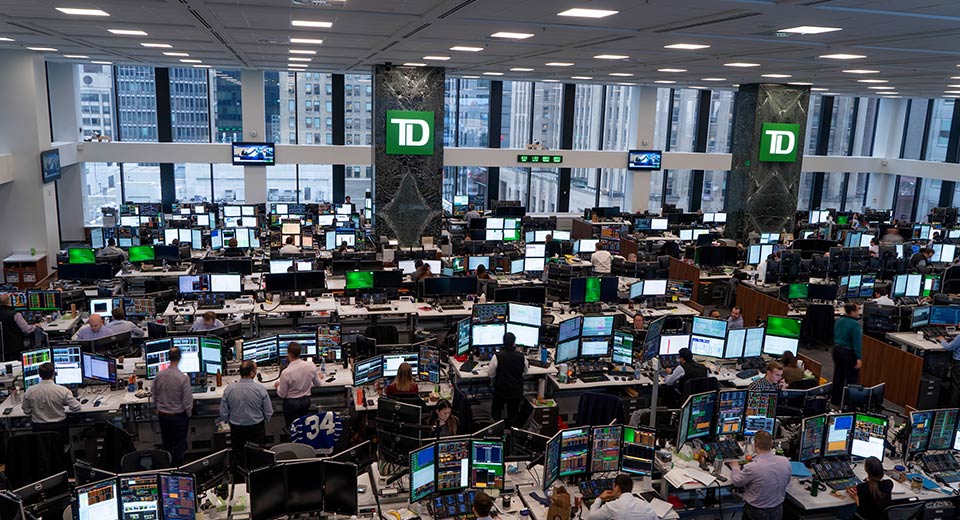
TD Securities is a leading investment bank providing corporate and investment banking and capital-markets services. Risk and regulatory reporting at this scale means unifying enormous daily transaction volumes into a single, auditable view.
The challenge
A big-data intake built for billion-record days
Alphavima engineered a scalable Hadoop and Spark intake framework that lands, validates and consolidates trade records from every line of business into one centralised risk platform. Distributed processing absorbs daily volume with headroom, ending the performance ceiling of the previous estate. On top of the unified data sits a threshold-based rule engine for anomaly detection: risk conditions are evaluated as data arrives, raising alerts early instead of during month-end review. The reporting layer was structured for governance from day one, keeping compliance teams and regulators working from the same numbers.
From fragmented reports to a governed platform
Discovery & data mapping
Trade flows, volumes and regulatory obligations mapped across every LOB.
Intake framework
Hadoop and Spark pipeline build with validation at ingestion.
Rule engine
Threshold-based anomaly detection tuned with the risk team.
Governed rollout
LOB-by-LOB onboarding onto the unified platform.
What changed
- No unified risk reporting platform
- 1B+ records/day with performance issues
- No early risk detection, regulatory misalignment
- Centralised risk reporting across all LOBs
- Scalable Hadoop + Spark intake framework
- Threshold rule engine, governance-ready reporting
Questions about projects like this
Can this scale beyond a billion records a day?
Yes. The intake framework is horizontally scalable: adding processing capacity is a configuration exercise, not a re-architecture. The design brief was growth headroom from day one.
Does a platform like this only suit banks?
No. The same pattern, high-volume intake, unified model, rule-based alerting, fits insurers, payment processors, utilities and any organisation drowning in event data.
How do you handle regulatory change?
Reporting logic is separated from the data model, so a new regulatory requirement becomes a new output view rather than a pipeline rebuild.
What does an engagement like this cost?
It depends on data volume, source complexity and alerting scope. We scope it in a structured discovery and price phase one fixed before you commit.