












Customer expectations have shifted, and businesses today can’t afford to rely on outdated methods to manage relationships. CRM systems, once used only to track interactions and manage contacts, are now evolving with artificial intelligence (AI) at their core. The result? Smarter, faster, and more connected experiences – for both businesses and customers.
Let’s take a look at how AI is reshaping CRM operations and why companies using Microsoft Dynamics 365 are leading the change.
Talk to a Dynamics 365 CRM consultant
Book a quick call to talk through your Dynamics 365 CRM project. No pressure, just practical advice. Or see our Dynamics 365 CRM services.
AI-Driven CRM: What’s Different Now?
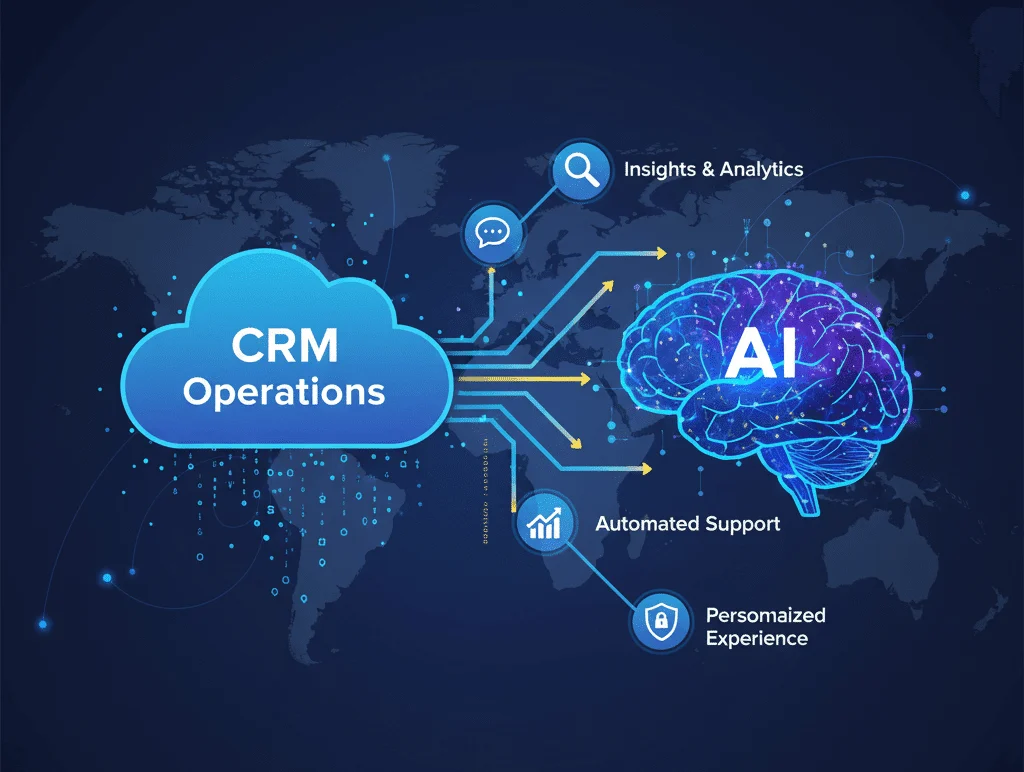
Modern CRMs are no longer just digital Rolodexes. With AI, they now deliver insights, recommendations, and automation. Here’s how:
> Predictive Lead Scoring: AI evaluates customer behavior, engagement history, and demographics to prioritize leads that are more likely to convert. Learn more about predictive analysis in 2025.
> Sales Forecasting: Machine learning models analyze historical sales patterns and current trends to forecast revenue more accurately.
> Automated Customer Service: AI bots and virtual agents can now handle routine inquiries, freeing up support teams to focus on more complex issues.
> Smart Recommendations: CRMs can suggest next-best actions, products, or messaging based on real-time customer data and activity.
Microsoft Dynamics 365 and AI Integration
Microsoft Dynamics 365 is at the forefront of integrating AI into CRM workflows. Here’s how:
1. Microsoft Copilot in Dynamics 365
The integration of Copilot AI into Dynamics 365 enables teams to work more efficiently. It assists with:
Generating email responses and sales notes
Summarizing customer interactions
Recommending tasks and follow-ups
Preparing meeting briefings automatically
This not only saves time but also reduces the manual effort required to maintain records and follow up with prospects.
2. Azure AI Services
Leveraging Azure OpenAI Service, Dynamics CRM can incorporate natural language processing, intelligent chatbots, and language translation-all useful for improving customer engagement and internal productivity.
3. Power Platform with AI Builder
Tools like Power Automate, Power Apps, and AI Builder empower businesses to add intelligence to custom apps. For example:
Automate email classification or routing
Extract insights from customer feedback
Detect sentiment in service cases
Real-World Benefits of AI-Enabled CRM
Better Customer Understanding: AI surfaces trends and behavior that aren’t obvious in raw data.
Faster Decision Making: Get recommendations in real-time based on live data.
Improved Personalization: Deliver tailored experiences at scale.
Increased Efficiency: Reduce manual tasks with automation, from data entry to scheduling.
Enhanced Sales and Support: Focus on high-value interactions while AI handles repetitive tasks.
What Tech Stack Supports This Transformation?
If you’re considering upgrading your CRM with AI, here are some key tools that support seamless integration:
| Technology Stack | Role in CRM-AI Integration |
|---|---|
| Microsoft Dynamics 365 Sales/Customer Service | Core CRM platform with AI features |
| Copilot for Dynamics 365 | AI-powered assistant across sales and service |
| Azure Machine Learning | Build and deploy predictive models |
| Power Automate | Workflow automation using AI triggers |
| Power BI | Data visualization and business intelligence |
| AI Builder | No-code AI models for use in apps and flows |
Looking Ahead
AI in CRM isn’t a future concept-it’s already here, enabling smarter processes and deeper insights. For businesses using Microsoft technologies, the transition is smoother and the benefits are more immediate.
If you’re currently on Dynamics 365 or planning to integrate AI with your CRM systems, Alphavima can help. Our team supports companies in leveraging tools like Copilot, Azure AI, and Power Platform to build CRM environments that are data-driven, intelligent, and ready for the next stage of growth.
Need help integrating AI with your CRM?
Let’s talk about how Alphavima can tailor AI-enabled CRM solutions to fit your business needs.
Ready to bring AI into your CRM?
Alphavima helps businesses integrate AI with Microsoft Dynamics 365 using tools like Copilot, Azure AI, and Power Platform. Get practical guidance to automate workflows, improve insights, and scale customer engagement.

Related case study
PWSC Unifies Sales, Warranty & Claims on Dynamics 365
PWSC brought sales, warranty and claims onto one Dynamics 365 CRM, with self-serve portals for builders and homeowners.
Read the case study · Next read: Dynamics 365 Customer Engagement licensing explained
FAQs
What Is AI in CRM and how is it being used by businesses today?
AI in CRM combines artificial intelligence with customer relationship management systems. First, businesses use AI to analyze customer data patterns. These patterns reveal buying behavior and churn risk. Second, sales teams use AI-powered lead scoring to prioritize their pipeline. Additionally, AI tools send follow-up reminders automatically. They reduce manual tasks for account managers.
Moreover, customer service teams use AI chatbots for instant responses. These bots handle routine questions without human intervention. Furthermore, AI forecasts revenue based on pipeline activity. As a result, managers make better decisions faster. Our Microsoft Copilot Studio team in Toronto helps businesses deploy AI features within Dynamics 365.
What does Artificial Intelligence actually do within a customer platform?
AI performs several tasks inside a customer platform. First, it reads and classifies incoming emails. It routes them to the right team member automatically. Second, AI analyzes conversation sentiment in customer communications. This helps managers spot dissatisfied customers early. Additionally, AI generates meeting summaries after sales calls. Teams review them instead of taking notes.
Moreover, AI suggests the next best action for each deal. Sales reps follow clear, data-driven steps. Furthermore, AI identifies cross-sell and upsell opportunities from transaction history. As a result, revenue per customer increases without extra effort. In contrast, manual analysis of the same data takes hours every week.
What role does Microsoft Copilot play in Dynamics 365 operations?
Microsoft Copilot brings AI capabilities directly into Dynamics 365. First, Copilot drafts email responses for sales and service staff. Teams review and send them in seconds. Second, Copilot summarizes long customer records on demand. Reps prepare for calls in minutes rather than hours. Additionally, Copilot generates reports from natural language commands. No query language knowledge is necessary.
Moreover, Copilot suggests actions based on the context of each record. These suggestions improve with use over time. Furthermore, Copilot integrates with Microsoft Teams, Outlook, and SharePoint. As a result, AI assistance appears across the tools your team already uses. This makes adoption faster and less disruptive for staff.
How does Azure AI extend the capabilities of Enterprise CRM platforms?
Azure AI adds enterprise-grade intelligence to CRM platforms. First, Azure Machine Learning builds custom predictive models. These models train on your own business data. Second, Azure AI Search enables smart document retrieval within CRM. Agents find answers faster during customer calls. Additionally, Azure OpenAI Service connects large language models to CRM workflows. Companies build custom AI features without starting from scratch.
Moreover, Azure AI Vision extracts data from uploaded documents. Forms, contracts, and invoices process automatically. Furthermore, Azure AI connects to Dynamics 365 through standard APIs. As a result, businesses deploy sophisticated AI without replacing their existing CRM. This approach protects your technology investment and reduces risk.
What business benefits do organizations see from intelligent CRM features?
AI in CRM delivers measurable business benefits. First, sales teams close deals faster. AI prioritizes leads and suggests the right contact time. Second, customer service teams resolve cases more quickly. AI surfaces relevant articles and past interactions in seconds. Additionally, marketing teams send more targeted campaigns. AI segments audiences based on behavior rather than demographics.
Moreover, operations managers forecast demand more accurately. AI models account for seasonal patterns and market shifts. Furthermore, automated outreach replaces repetitive manual tasks. As a result, organizations see higher return on their CRM investment. Our nonprofit CRM team in Toronto implemented these benefits across mission-driven organizations successfully.
Which Microsoft tools support intelligent automation in customer operations?
Microsoft offers several tools that support AI in CRM and automation. First, Power Automate handles workflow automation without code. It connects CRM events to actions across Microsoft 365. Second, Microsoft Copilot for Sales embeds AI directly into Outlook and Teams. Reps get suggestions inside the tools they already use. Additionally, Azure Logic Apps orchestrate complex multi-step integrations. These include third-party systems outside the Microsoft ecosystem.
Moreover, Power BI visualizes CRM data with AI-driven insights. Managers spot trends before they become problems. Furthermore, Dataverse stores all CRM data in a structured, AI-ready format. As a result, every Microsoft tool shares the same data foundation. This makes AI outputs more accurate and consistent across your organization.
Is AI in CRM technology accessible for small and mid-sized businesses?
AI in CRM technology is accessible for businesses of all sizes. First, Microsoft 365 Copilot licenses include AI features at a per-user price. Small teams adopt AI without large upfront investment. Second, Power Automate and Power Apps offer no-code automation. Non-technical staff build workflows independently. Additionally, Copilot Studio builds custom AI agents without developer skills. These agents answer customer questions automatically.
Moreover, Alphavima provides structured implementation plans for smaller organizations. We start with high-impact use cases first. Furthermore, cloud-based deployment means no infrastructure investment. As a result, mid-sized businesses compete with larger enterprises using the same AI tools. Explore our Power Apps developer team in Toronto to get started today.
How does Alphavima help organizations integrate AI in CRM systems?
Alphavima integrates AI in CRM systems through a structured five-step process. First, we assess your current Dynamics 365 environment. We identify where AI adds the most immediate value. Second, we configure Microsoft Copilot features for your team. This covers sales, service, and operations workflows. Additionally, we connect Azure AI services to your CRM data. These connections enable predictive and generative AI features.
Moreover, we train your team to use AI tools effectively. Adoption drives the return on investment. Furthermore, we provide ongoing support as Microsoft releases new AI capabilities. As a result, your CRM evolves continuously without major re-implementation projects. Review the Microsoft Dynamics 365 Copilot documentation to explore available AI features.