








Choosing between Business Central vs SAP Business One is one of the more common ERP decisions facing small and mid-market companies, and both platforms have earned their place in the market. They serve similar buyers, yet they take noticeably different paths on deployment, pricing, and how tightly the software connects to the rest of your stack.
This guide keeps things objective. We compare the two on cost, features, and fit, and we point out where SAP wins as honestly as where Microsoft does. The goal is a clear-eyed view, not a sales pitch, so you can match the right ERP to your industry, your existing tools, and your budget.
At a Glance: How the Two Platforms Differ
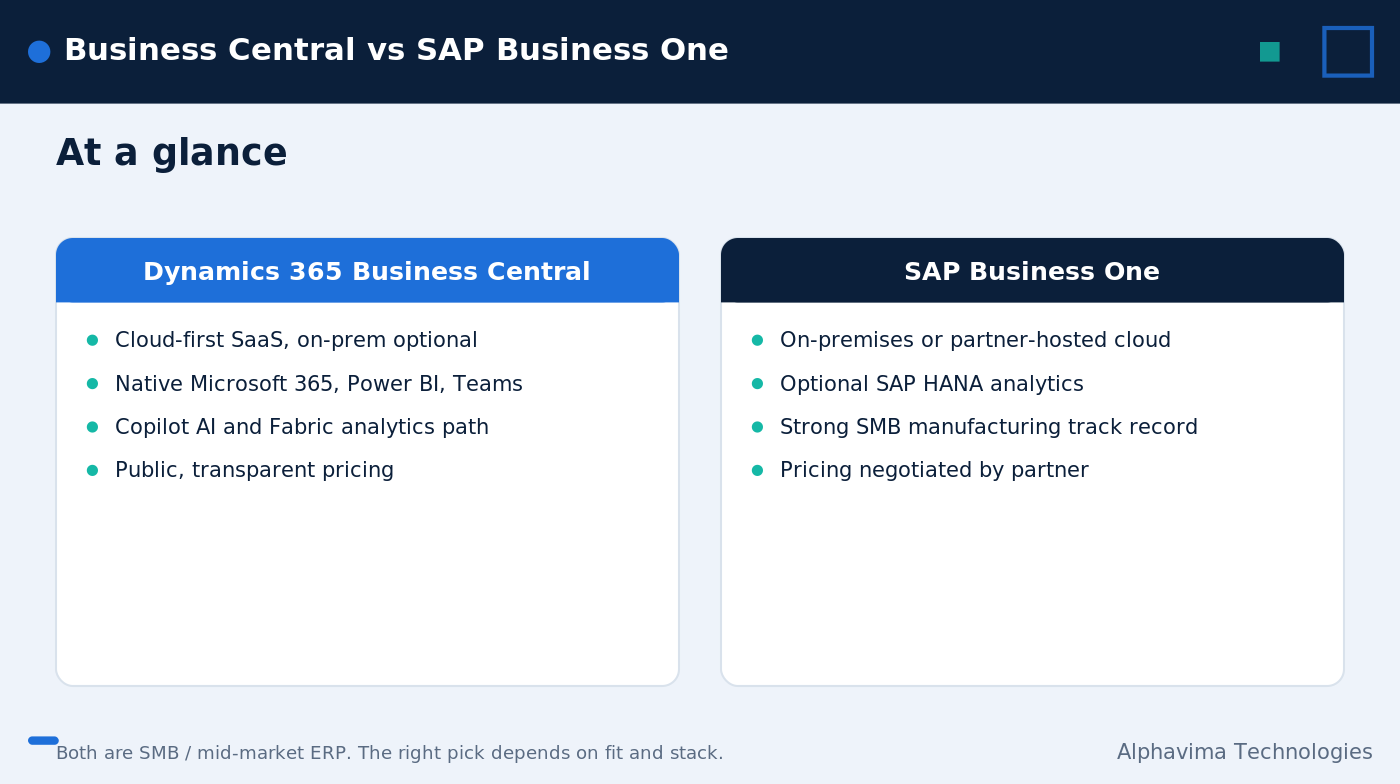
Microsoft Dynamics 365 Business Central is a cloud-first SaaS ERP. SAP Business One, by contrast, can run on-premises with a perpetual license or as a hosted/cloud subscription through SAP partners. That single difference shapes much of the rest of the comparison, from pricing structure to update cadence.
Here is a side-by-side summary to set the stage. The table below covers vendor, deployment, pricing model, Microsoft integration, AI features, and marketplace depth.
| Attribute | Business Central | SAP Business One |
|---|---|---|
| Vendor | Microsoft | SAP |
| Deployment | Cloud-first SaaS | On-premises (perpetual) or hosted/cloud via partners |
| Pricing model | Public, per user/month | Varies by partner/region; often negotiated |
| Microsoft 365 integration | Native (Outlook, Excel, Teams) | Limited/third-party |
| AI features | Copilot built in | Optional, partner-dependent |
| Marketplace | 4,000+ AppSource apps | Established SAP partner channel |
| Updates | Twice-yearly cloud releases | Varies by deployment |
Pricing Comparison (USD, as of 2026)
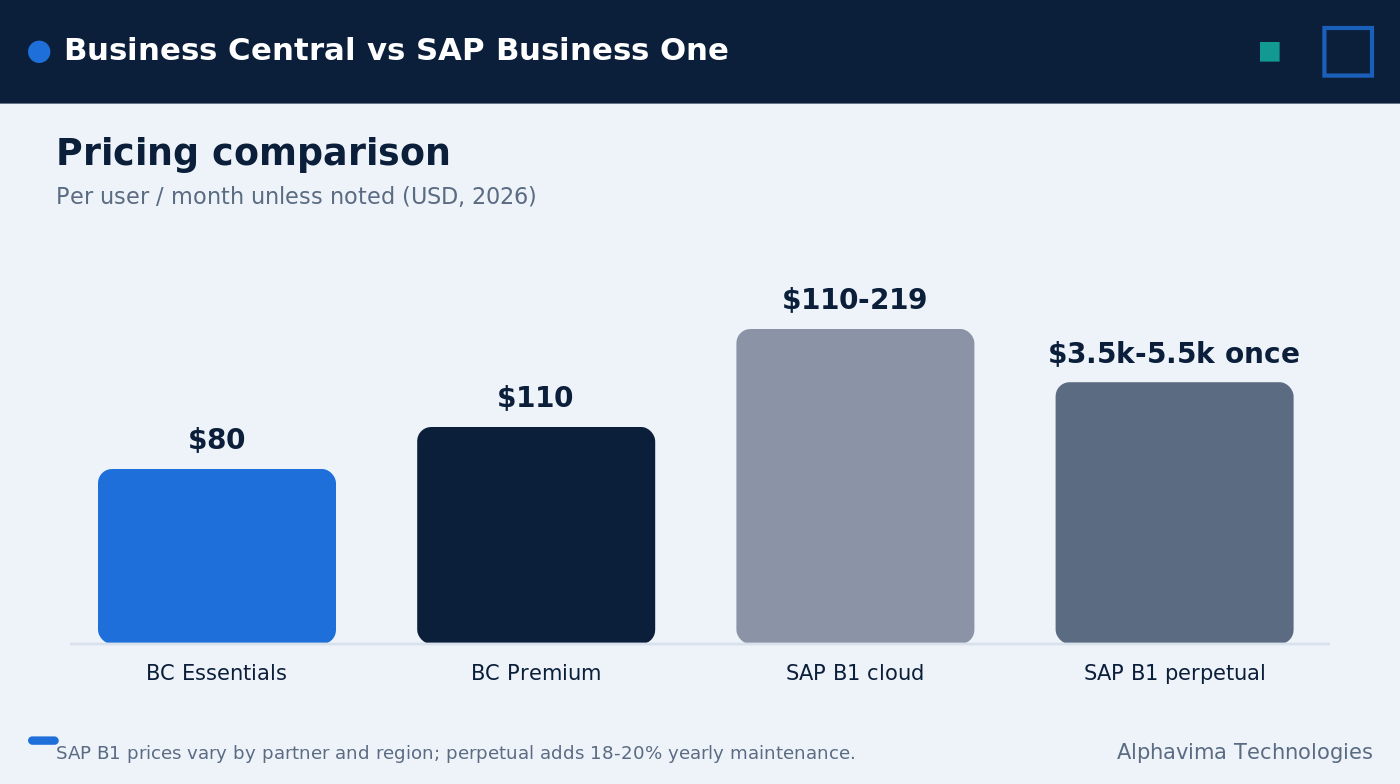
Pricing is where the two platforms diverge most clearly, so it deserves a careful look. Business Central publishes transparent, public pricing. SAP Business One pricing, on the other hand, commonly depends on the partner, region, license type, and deployment, and figures are often negotiated.
As of 2026, Business Central cloud pricing is straightforward: Essentials runs $80 per user per month (annual), Premium runs $110, and Team Members cost $8. You can review the current figures on the Microsoft pricing page.
SAP Business One follows a different model. Cloud subscriptions commonly fall roughly $110–$219 per user per month depending on license type (Professional, Limited, Starter). Perpetual on-premises licenses commonly run about $3,500–$5,500 per named user as a one-time fee, plus annual maintenance of about 18–20% of license cost. Implementation services commonly land at $15,000–$50,000 or more.
Note: SAP Business One prices vary by partner and region; treat ranges as directional, not fixed quotes.
| Item | Business Central (cloud) | SAP Business One |
|---|---|---|
| Full user (cloud, monthly) | Essentials $80 / Premium $110 | ~$110–$219 (Professional/Limited/Starter) |
| Light user | Team Members $8 | Varies by partner |
| Perpetual license | Not applicable (SaaS) | ~$3,500–$5,500 per named user (one-time) |
| Annual maintenance | Included in subscription | ~18–20% of license cost |
| Typical implementation | Varies by scope | ~$15,000–$50,000+ |
For a fuller breakdown of Microsoft’s licensing, see our Business Central pricing guide.
Feature and Fit: A Closer Look
Pricing tells part of the story, yet feature fit often decides the outcome. Both platforms cover core ERP ground: finance, sales, purchasing, inventory, and reporting. Where they part ways is in how they connect to other tools and how they handle analytics and AI.
Where Business Central Pulls Ahead
Business Central is built around the Microsoft ecosystem, and that integration is native rather than bolted on. Outlook, Excel two-way editing, and Teams all connect directly. Reporting flows into Power BI without extra middleware, and process automation runs through Power Automate.
On top of that, Copilot AI features ship inside the product, and there is a native path into Microsoft Fabric and OneLake for analytics. The AppSource marketplace adds more than 4,000 apps, and the platform receives twice-yearly cloud updates. For documentation, Microsoft maintains detailed guides on Microsoft Learn, and you can browse extensions on AppSource. One practical example of native depth is compliance handling, which we cover in our post on Business Central electronic documents.
Where SAP Business One Holds Its Ground
SAP Business One brings its own clear strengths, and it would be unfair to overlook them. It has a long track record with SMB manufacturers and distributors, and its core inventory and production functions suit certain industries well. The optional SAP HANA in-memory engine adds strong analytics for organizations that want it.
SAP Business One also keeps the on-premises option alive, which matters for companies that require local control of data and infrastructure. A mature global SAP partner channel supports the product, and it naturally appeals to companies already standardized on SAP elsewhere in the business.
| Capability | Business Central | SAP Business One |
|---|---|---|
| Microsoft 365 connection | Native, two-way | Limited |
| Built-in AI | Copilot included | Optional, partner-led |
| In-memory analytics | Power BI / Fabric path | SAP HANA option |
| On-premises deployment | No (cloud SaaS) | Yes (perpetual) |
| Industry strength | Microsoft-centric SMBs | Manufacturing/distribution |
| Cost predictability | High (public pricing) | Varies by partner |
Where SAP Business One Wins
To be fair in this Dynamics 365 vs SAP Business One discussion, SAP Business One is a credible choice in several real situations. It tends to win when:
- Your company is already standardized on SAP across other functions.
- You have specific manufacturing or distribution needs that its core inventory and production tools serve well.
- You require an on-premises deployment for data control or regulatory reasons.
- You value the SAP HANA in-memory analytics option.
- You prefer a perpetual license model over a subscription.
In short, the SAP Business One comparison favors SAP when alignment, industry fit, or deployment control matters more than ecosystem integration.
Where Business Central Wins
On the other side of this Microsoft ERP vs SAP comparison, Business Central tends to win when:
- Your organization runs on Microsoft 365 and wants native Office integration.
- You prefer a cloud-first strategy with predictable, twice-yearly updates.
- You want tight Power Platform and Copilot AI integration without extra tooling.
- You value transparent, public pricing and lower typical total cost of ownership.
- You expect to grow your app footprint through AppSource over time.
As an SAP Business One alternative, Business Central appeals most to Microsoft-centric teams that want fewer moving parts and a clearer cost picture.
A Note on Migration
Some companies running SAP Business One later decide to move to Business Central, often to consolidate on Microsoft tools or shift fully to the cloud. That move is well established, and it does not have to be disruptive when planned properly.
If you are weighing such a change, our guide on SAP Business One to Business Central migration walks through the path. Alphavima also runs independent ERP evaluations and migrations, so the recommendation follows your needs rather than a single product line. You can learn more through our ERP consulting services.
Choosing between Business Central and SAP Business One?
Get an independent ERP assessment from Alphavima and a clear recommendation for your business.
Conclusion
Both platforms are credible, and neither is a default winner. SAP Business One earns its place for SAP-aligned groups, certain manufacturing and distribution needs, and on-premises requirements. Business Central tends to win for Microsoft 365 shops, cloud-first plans, tighter Office, Power Platform, and AI integration, and a more predictable, lower cost.
So the right answer to Business Central vs SAP Business One depends on your industry fit, your existing stack, your deployment preference, and your budget. If you want an objective, vendor-neutral evaluation, Alphavima can help you compare both, model the costs, and plan an implementation or migration. Reach out through our ERP consulting services to start the conversation.
FAQs
Which is cheaper, Business Central or SAP Business One?
In most cloud scenarios, Business Central tends to have lower and more predictable total cost of ownership, with public pricing of $80–$110 per full user per month as of 2026. SAP Business One pricing varies by partner and license, so compare full quotes before deciding.
Is SAP Business One available in the cloud?
Yes. SAP Business One can run as a hosted or cloud subscription through SAP partners, and it also remains available on-premises with a perpetual license. Business Central is cloud-first SaaS.
Does Business Central include AI features?
Yes. Copilot AI features ship inside Business Central, and there is a native path into Microsoft Fabric and OneLake for analytics. SAP Business One offers AI through optional, partner-dependent paths.
Is Business Central a good SAP Business One alternative?
For Microsoft-centric, cloud-first organizations, Business Central is a strong SAP Business One alternative thanks to native Microsoft 365 integration, transparent pricing, and a large AppSource marketplace. The best fit still depends on your industry and stack.
Can I move from SAP Business One to Business Central?
Yes. Companies regularly move off SAP Business One to Business Central. A planned migration handles data, processes, and integrations in stages, and a partner-led evaluation helps confirm the move is right for you.
Which platform is better for manufacturing?
SAP Business One has a long track record with SMB manufacturers and distributors, and its core production and inventory tools fit certain industries well. Business Central also serves manufacturing, often paired with AppSource extensions, so evaluate both against your specific processes.
Does pricing change by region or partner?
Yes, especially for SAP Business One, where figures are often negotiated by partner and region. Treat the ranges in this Business Central vs SAP B1 comparison as directional, and request formal quotes for accurate numbers.


