











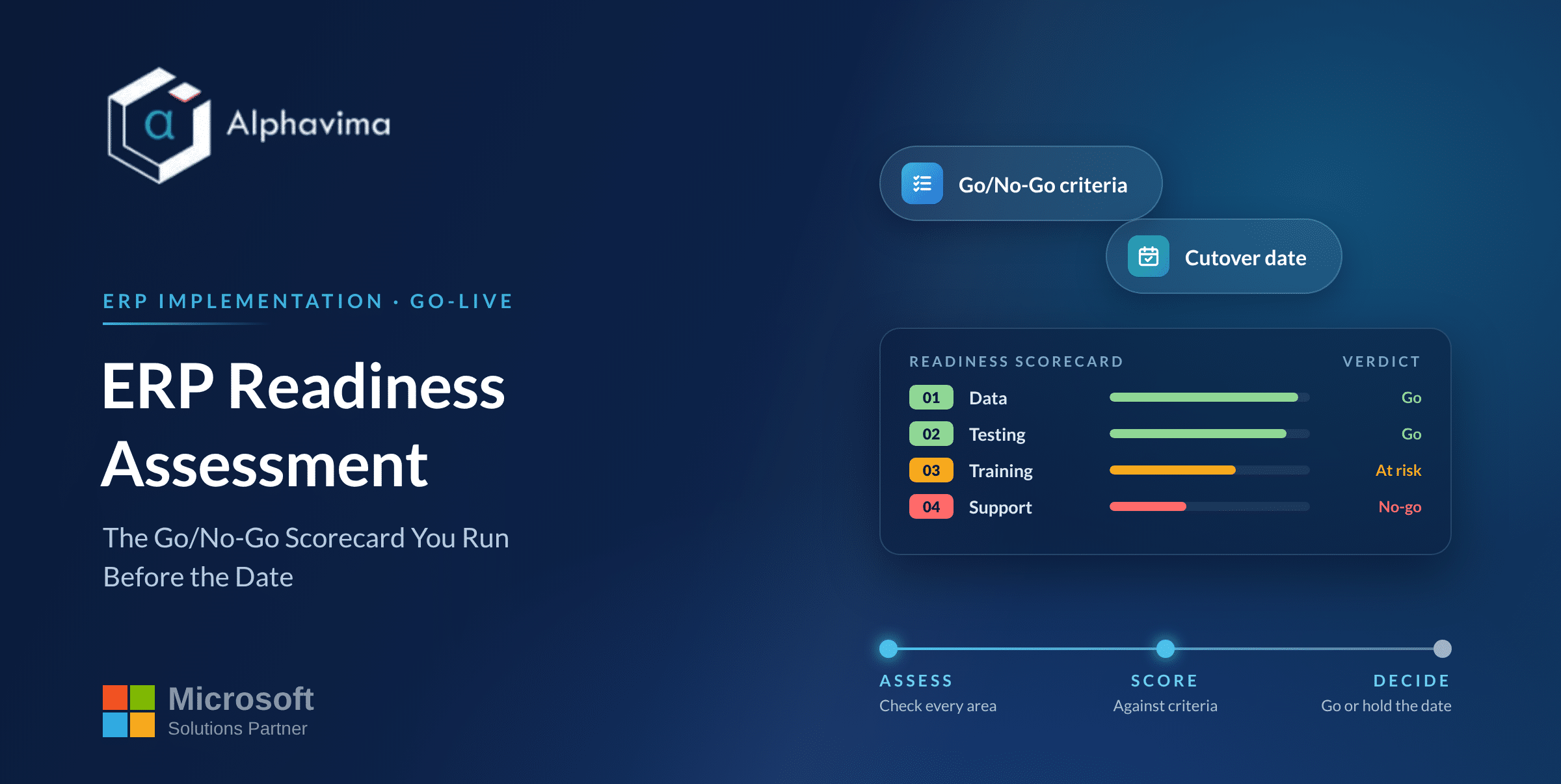
Six weeks before go-live somebody will ask whether you are ready. If the answer is a colour, a percentage complete or a confident nod from the person whose bonus depends on the date, you do not have a readiness assessment. You have a mood.
A proper ERP readiness assessment is a scored instrument with weights, evidence requirements and thresholds agreed before anyone knows the result. It is deliberately uncomfortable. It exists to make a bad answer visible early enough to act on, which is the only useful thing a readiness review can do.
This is distinct from the post mortem question. Why ERP implementations fail diagnoses causes after the wreckage. This article is the decision you make before the date, while you still have options.
Table of contents
Why a scorecard rather than a checklist
Checklists tell you whether something exists. Scorecards tell you whether it is good enough and how much it matters. Those are different questions, and go-live is decided by the second one.
A checklist item reading “data migration complete” is satisfied by a load that ran. A scored criterion reading “final data load reconciled to legacy control totals with all variances documented and accepted by the financial controller” is satisfied by a signature. One of those survives the audit.
Weighting matters for the same reason. If your training completion is at 60 per cent and your interface error queue has 400 unresolved messages, those are not equally serious, and an unweighted checklist will treat them as though they were.
Gartner predicts that by 2027 more than 70 per cent of recently implemented ERP initiatives will fail to fully meet their original business goals, and the failures cluster around adoption and data integrity rather than around unfinished configuration.
Weight accordingly.
The five dimensions and their weights
Score each criterion from 0 to 5. Zero means not started. Five means complete, evidenced and accepted by a named owner. There are no half marks for “in progress”, because in progress at three weeks out is not a state, it is a risk.
| Dimension | Weight | What it is really testing |
|---|---|---|
| Data readiness | 30% | Can finance sign the opening balance sheet |
| Process readiness | 20% | Can the business run end to end without a consultant present |
| People readiness | 20% | Will anyone be able to do their job on Monday |
| Technical readiness | 20% | Will the system stay up and will the interfaces behave |
| Business readiness | 10% | Have the outside world and the support model been told |
Data carries the largest weight because it is the only dimension that cannot be fixed after go-live without enormous cost. A badly trained user improves in a fortnight. A wrong opening trial balance contaminates every report for a year.
Data readiness (weight 30%)
| # | Criterion | Evidence required | Score 0-5 |
|---|---|---|---|
| D1 | Final data load has been executed at full volume in a non production environment | Timed run log from the most recent mock cutover | |
| D2 | Reconciliation pack produced, with control totals for AR, AP, GL, inventory and fixed assets | Signed pack, one line per control total | |
| D3 | All variances documented, quantified and formally accepted | Variance log with named acceptor per line | |
| D4 | Opening balance journal drafted and reviewed by the financial controller | Draft journal with reviewer sign-off | |
| D5 | Master data duplicates identified and resolved, not just counted | Before and after duplicate counts by entity | |
| D6 | Historical data scope agreed in writing, with the archive route defined | Signed scope decision plus archive location |
Process readiness (weight 20%)
| # | Criterion | Evidence required | Score 0-5 |
|---|---|---|---|
| P1 | Every critical business process has been executed end to end in the target environment | Process execution log referencing UAT scripts | |
| P2 | Finance has closed a practice period in the new system | Practice close pack: TB, P&L, balance sheet, reconciliations | |
| P3 | Month end close calendar rewritten for the new system and agreed with finance | Dated close calendar with task owners | |
| P4 | Workarounds for unresolved defects are documented and the owners trained on them | Workaround register, one page per item | |
| P5 | Authorisation and approval hierarchies configured and tested with real approvers | Test evidence per approval route |
Criterion P2 is the one that separates serious readiness assessments from theatre. Running a practice month end close in the new system, with real migrated data, produces more genuine defects than any other single activity.
Teams skip it because it is expensive and inconvenient, and then discover in month one that the consolidation does not balance.
People readiness (weight 20%)
| # | Criterion | Evidence required | Score 0-5 |
|---|---|---|---|
| U1 | Training delivered to all users who will transact from day one | Attendance record against the full user list | |
| U2 | Competency verified, not merely attendance recorded | Assessment results or observed task completion | |
| U3 | Payroll has been run end to end in the new system against a real period | Parallel payroll comparison, gross to net, per employee | |
| U4 | Security roles assigned and spot checked against the role matrix | Sample of users per role with screenshots | |
| U5 | Super users identified, trained beyond end user level and rostered for hypercare | Named roster with coverage by shift and site | |
| U6 | Key person risk assessed, with a named backup for each critical role | Backup list per cutover runbook line |
U3 deserves its bold type. Payroll is the one process where an error is immediately visible to every employee, legally consequential and impossible to hide. If payroll is in scope and nobody has run a full parallel calculation to net pay, you are not ready, whatever the rest of the scorecard says.
Technical readiness (weight 20%)
| # | Criterion | Evidence required | Score 0-5 |
|---|---|---|---|
| T1 | Production environment provisioned, sized and on a supported version | Environment record with version and capacity | |
| T2 | Interface error queue is empty in the pre production environment | Screenshot of zero unresolved messages, dated | |
| T3 | Performance tested at realistic production volume and concurrency | Test report with response times against agreed targets | |
| T4 | Backup and restore tested, with a measured restore time | Restore test log showing elapsed time | |
| T5 | Integrations tested in both directions with the actual counterparties | One test message each way per interface, confirmed by counterparty | |
| T6 | Monitoring and alerting configured with a named recipient per alert | Alert configuration export |
T2 is uncomfortable for a reason. Almost every project reaches go-live with a non empty error queue and a shared belief that most of those messages are noise. Occasionally that is true. More often the queue contains three real failures hidden among two hundred duplicates, and nobody has looked because the number is too large to face.
Empty it, or explain every remaining message.
Business readiness (weight 10%)
| # | Criterion | Evidence required | Score 0-5 |
|---|---|---|---|
| B1 | Customers, suppliers and banks notified of any change affecting them | Communication log with dates and recipients | |
| B2 | Support model defined with first, second and third line and an escalation path | Support model document with named contacts | |
| B3 | Hypercare roster staffed, including out of hours cover | Rota covering the first two weeks | |
| B4 | Cutover plan signed off by all task owners | Signed runbook | |
| B5 | Statutory and regulatory reporting obligations in the go-live period identified | Calendar of filing dates against the cutover window |
Scoring and thresholds
Calculate each dimension as a simple percentage of the maximum available, then apply the weights for an overall score.
| Overall score | Any dimension below 60% | Any red flag criterion below 4 | Decision |
|---|---|---|---|
| 85% or above | No | No | Go |
| 70% to 84% | No | No | Conditional go: proceed with a named owner and a dated plan for each gap |
| 70% or above | Yes | No | Conditional go, escalated: the weak dimension needs a separate remediation gate before the cutover starts |
| Any | Any | Yes | Stop: reschedule |
| Below 70% | Any | Any | Stop: reschedule |
The red flag criteria are D2, D3, P2, U3 and T2. A score below 4 on any of them stops the go-live regardless of the total. This is the mechanism that prevents a strong overall number from concealing a fatal specific.
A project can be 88 per cent ready and still be unable to pay its staff.
Two rules make the thresholds real rather than decorative. Agree them in writing before the first scoring round, because thresholds set after you know the score are not thresholds. And require evidence, not assertion. A criterion is scored on what has been produced, not on what someone is confident about.
Run it three times, not once
A single readiness assessment at minus two weeks is a formality. Run it at minus eight weeks, minus four weeks and minus one week, with the same criteria each time.
The first run is diagnostic. Expect a low score and treat it as information rather than an accusation. It identifies which dimension needs money and attention over the next month.
The second run is the real decision point. At minus four weeks you can still add a training cohort, run another mock cutover, or move the date without incurring most of the cancellation cost.
Moving a date at minus four weeks is a management decision. Moving it at minus three days is an incident.
The third run confirms that the conditional items closed. It should be short and boring.
Microsoft’s implementation guidance makes the same point: the team should assess go-live readiness early and often, with each assessment showing the status, readiness, completeness and maturity of each activity so that stakeholders can make a well informed go/no-go decision. The readiness review is a quality gate, not a status report.
Would your project survive an honest readiness score?
Alphavima runs independent go-live readiness assessments against a weighted scorecard, with evidence requirements and thresholds agreed before scoring begins. Book a readiness review and find out where you really are while there is still time to fix it.
Who scores, and who decides
Separate the two. The person who scores should not be the person whose date is at stake.
Scoring works best when each dimension is owned by the function accountable for it: the financial controller scores data, process owners score process, the HR or operations lead scores people, the IT lead scores technical, the project manager scores business.
Each brings evidence. A neutral chair, often the internal audit function or an independent reviewer, challenges the evidence and holds the line on what a 5 means.
The decision then sits with the executive sponsor, advised by the steering committee. Independent review is a well established control pattern here; ISACA’s audit programs and tools library covers the assurance angle on system implementation and change management, and borrowing that mindset for a pre go-live review is cheap insurance.
The point is not bureaucracy. It is that the person who has spent nine months defending a date is the worst possible person to judge whether it should move.
For the people side of the score specifically, treat adoption as a planned discipline rather than a hope. The Project Management Institute’s Managing Change in Organizations: A Practice Guide reports that only around 20 per cent of organisations have adopted a formal organisational change management practice, which broadly matches how often a readiness assessment finds the people dimension genuinely prepared.
What a conditional go actually means
Conditional go is the most abused outcome on this scorecard. It is frequently used to mean “go anyway”, which defeats the purpose.
A legitimate conditional go has four properties. Each open gap has a named owner, a dated completion, a defined evidence item and a stated consequence if it is not closed by the cutover start.
Write the consequence down. “If interface error queue is not empty by Thursday 17:00, integrations remain disabled at go-live and orders are keyed manually for the first week” is a plan. “We will keep an eye on it” is not.
If you cannot write the consequence, the item is not a condition. It is a blocker, and the answer is stop.
Once the score supports a go, the assessment feeds directly into the cutover plan, where each remaining condition becomes a line with a verification step and a rollback action. The evidence you gathered during user acceptance testing supplies most of the process readiness score, which is why UAT exit criteria and readiness criteria should be drafted together rather than six weeks apart.
Frequently asked questions
What is an ERP readiness assessment?
It is a scored evaluation of whether a project should go live on the planned date, covering data, process, people, technical and business readiness. Each criterion is scored against evidence rather than opinion, dimensions are weighted, and the total is compared against thresholds agreed before scoring begins.
How is a readiness assessment different from a go-live checklist?
A checklist records whether something exists. A readiness assessment records how good it is, how much it matters and what evidence proves it. A checklist can be fully ticked by a project that is not ready, because completion and sufficiency are different things.
When should we run the readiness assessment?
Three times: around eight weeks out for diagnosis, four weeks out for the real decision, and one week out to confirm conditional items have closed. Four weeks is the last point at which moving the date is a management decision rather than an incident.
What should stop a go-live outright?
Any red flag criterion scoring below 4: an unreconciled final data load, unaccepted variances, no practice period close by finance, no end to end payroll run, or a non empty interface error queue. Each of these is individually capable of causing months of remediation.
Who should own the readiness score?
Each dimension is scored by the function accountable for it, with evidence, challenged by a neutral chair. The go or no-go decision itself belongs to the executive sponsor advised by the steering committee. The person whose date is at stake should not be the person grading the work.
What counts as a legitimate conditional go?
Every open gap has a named owner, a dated completion, a defined evidence item and a written consequence if it is not closed before cutover begins. If you cannot state the consequence, the item is a blocker rather than a condition and the answer is to stop.
Does a high overall score mean we are ready?
Not on its own. A project can score 88 per cent overall and still be unable to run payroll or close a period. That is why red flag criteria override the total, and why any single dimension falling below 60 per cent triggers a separate remediation gate.