











Choosing a CRM is one of the few software decisions that touches every revenue team you have: sales, marketing, service and the operations people who report on all of it. For a mid-market organisation weighing Microsoft Dynamics 365 Sales against Salesforce Sales Cloud in 2026, the choice is rarely about which tool can store a contact.
Both do that well. It is about pricing over a five-year horizon, how the platform fits the rest of your stack, and how much it costs to change when your process changes.
This comparison is written for the mid-market buyer who wants a straight answer without the sales theatre. We will look at per-user pricing for both products, the AI assistants, the customisation models, the underlying data model, integration, total cost of ownership and migration.
Alphavima is a Microsoft partner, so we will be upfront about that, but a comparison only earns trust if it names the other side’s real strengths. Salesforce has plenty of them.
Key takeaway / What you’ll learn: Salesforce leads on app-marketplace breadth and brand maturity, while Dynamics 365 usually wins on price-to-value and total cost of ownership for organisations already running Microsoft 365. We show the verified 2026 pricing for both and a clear decision framework.
Table of contents
Talk to a Dynamics 365 CRM consultant
Book a quick call to talk through your Dynamics 365 CRM project. No pressure, just practical advice. Or see our Dynamics 365 CRM services.
At a glance: Dynamics 365 vs Salesforce
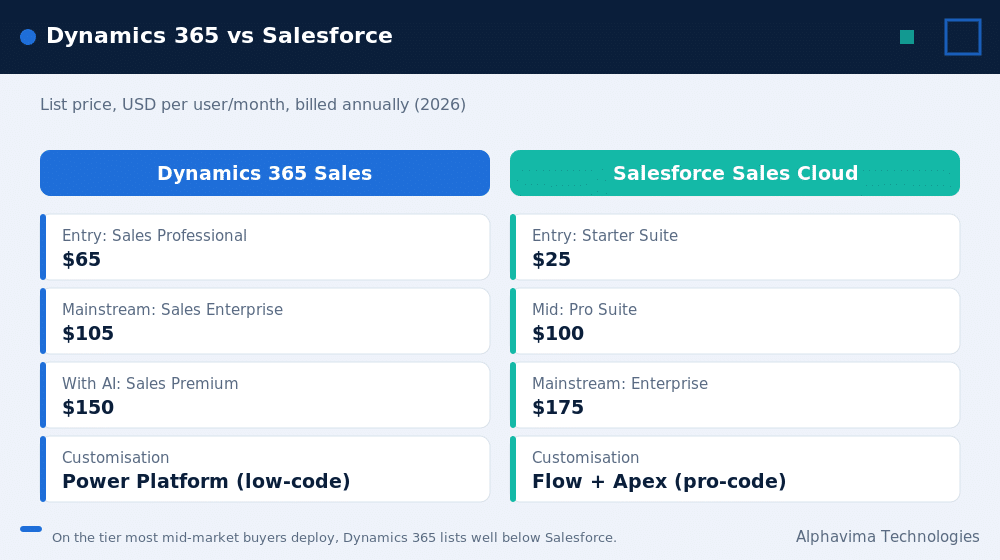
The table below summarises where each platform sits. All prices are list prices in USD per user per month, billed annually, taken from the official Microsoft and Salesforce pricing pages in 2026. Your negotiated price will differ.
| Factor | Microsoft Dynamics 365 Sales | Salesforce Sales Cloud |
|---|---|---|
| Entry tier | Sales Professional, $65 | Starter Suite, $25 |
| Mid tier | Sales Enterprise, $105 | Pro Suite, $100 |
| Upper tier | Sales Premium, $150 (AI included) | Enterprise, $175 |
| Top tier | Relationship Sales (variable, LinkedIn Sales Navigator) | Unlimited, $350; Agentforce 1 Sales, $550 |
| AI assistant | Copilot for Sales / Sales Agent | Einstein / Agentforce |
| Customisation | Power Platform (low-code), plus pro-code | Flow (low-code), Apex (pro-code) |
| Data model | Dataverse | Salesforce objects (SOQL) |
| Best for | Microsoft 365 / Teams-centric organisations | Firms wanting the largest app marketplace |
| Marketplace | Microsoft AppSource | Salesforce AppExchange (larger) |
| Ideal company size | SMB to large enterprise | SMB to large enterprise |
A quick note on reading that table: the entry tiers are not equivalent. Salesforce Starter at $25 is a genuinely capable small-team product, but it is a simplified suite, not a like-for-like match for Dynamics 365 Sales Professional.
The fair mid-market comparison is Sales Enterprise ($105) against Salesforce Enterprise ($175), and there the gap is real.
Pricing tiers, compared honestly
Microsoft Dynamics 365 Sales pricing has three named tiers plus a LinkedIn-bundled option:
- Sales Professional, $65 per user/month. Core sales-force automation: accounts, contacts, leads, opportunities, basic customisation.
- Sales Enterprise, $105 per user/month. The mainstream mid-market choice. Adds deeper customisation, forecasting, and more generous automation.
- Sales Premium, $150 per user/month. Bundles the AI capabilities (conversation intelligence and the Sales assistant) into a single per-user price.
- Microsoft Relationship Sales. Variable pricing with a 10-seat minimum, pairing Dynamics 365 Sales Enterprise with LinkedIn Sales Navigator.
Salesforce Sales Cloud pricing runs across more tiers:
- Starter Suite, $25 per user/month. A simplified all-in-one for small teams.
- Pro Suite, $100 per user/month. More customisation and automation than Starter.
- Enterprise, $175 per user/month. The tier most mid-market Salesforce buyers land on.
- Unlimited, $350 per user/month. Adds premium support, sandboxes and more.
- Agentforce 1 Sales, $550 per user/month. The top bundle with AI and unified data included.
The headline is straightforward. On the tier most mid-market buyers actually deploy, Dynamics 365 Sales Enterprise lists at $105 against Salesforce Enterprise at $175, and Dynamics 365 Sales Premium at $150 (with AI folded in) still sits below the Salesforce Enterprise line.
Salesforce owns the cheapest starting point at $25, which matters for a five-person team, but that advantage narrows sharply as you move up the ladder into real deployments.
Tip: List price is a starting line, not a finish line. Both vendors discount for multi-year commitments and volume. Get quotes for the same seat count and tier before you compare, and ask what each price excludes.
The Microsoft 365 ecosystem advantage
This is the factor that most often decides the outcome, and it has little to do with the CRM’s feature list. If your organisation already runs Microsoft 365, Outlook, Teams and Excel, Dynamics 365 lives inside that world natively.
Sellers work leads from the Outlook reading pane, log activity without leaving Teams, and drop CRM data into Excel with a live connection back to the source.
Salesforce integrates with Microsoft 365 too, and it does so competently, but it is integrating with a stack it does not own. Dynamics 365 shares the same identity (Microsoft Entra ID), the same security model and the same data platform as the tools your people already use every day.
For a Microsoft-centric organisation, that reduces friction, licensing overlap and the number of vendors in the room when something breaks.
The same logic extends to reporting. Power BI is Microsoft’s analytics tool, and it reads Dynamics 365 data through Dataverse without a connector tax. Salesforce customers frequently buy Tableau (a Salesforce company) or push data into a warehouse to get comparable analytics, which is capable but adds cost and moving parts.
AI: Copilot for Sales vs Einstein and Agentforce
Both platforms have made 2026 an AI arms race, and both have credible offerings.
On the Microsoft side, Copilot for Sales drafts emails, summarises opportunities, prepares call notes and surfaces CRM context inside Outlook and Teams. It is available to users with a Microsoft 365 Copilot licence, and the Sales-specific capabilities are bundled into Dynamics 365 Sales Premium.
Because it runs where your sellers already work (their inbox and their meetings), adoption tends to be less of a fight. If you want the wider picture, our write-up on AI in CRM platform comparison goes deeper on how these assistants differ in practice.
Salesforce’s Einstein and its agentic layer, Agentforce, are genuinely strong and, in some autonomous-agent scenarios, ahead. Salesforce has invested heavily here and markets it aggressively. The commercial model is worth understanding, though: Agentforce pricing is consumption-based, at $2 per conversation, or via Flex Credits at $500 per 100,000 credits (roughly $0.005 per credit, with standard actions costing 20 credits each).
That model scales with usage, which can be efficient or expensive depending on volume, and it makes budgeting less predictable than a flat per-user AI price. Microsoft’s per-user bundling in Sales Premium is easier to forecast; Salesforce’s consumption model can be cheaper at low volume and pricier at high volume.
Customisation: Power Platform vs Apex and Flow
Every CRM needs bending to fit the business. The two vendors take different routes.
Dynamics 365 is customised through the Power Platform: Power Apps for custom screens and apps, Power Automate for workflows, and Copilot Studio for AI agents. It is a low-code environment that a capable business analyst can work in, with a professional-developer path when you need it.
Because Power Platform is a general-purpose toolset, what you build for CRM can extend to the rest of the business, which spreads the investment. Our Power Platform services team spends most of its time exactly here.
Salesforce offers Flow for low-code automation and Apex, its proprietary programming language, for pro-code work. This is a mature, deep model, and the Salesforce developer community is enormous. The trade-off is that Apex is a Salesforce-only skill.
Power Platform skills, by contrast, transfer across the whole Microsoft estate. For an organisation trying to keep a lean team, a toolset that serves CRM and the wider business is easier to staff.
The data model: Dataverse vs Salesforce objects
Under Dynamics 365 sits Dataverse, Microsoft’s structured data platform. Under Salesforce sits its own object model, queried with SOQL. Both are solid relational stores with security, relationships and automation built in.
The practical difference is reach. Dataverse is shared across Power Apps, Power Automate, Power BI and Microsoft 365, so CRM data is available to the rest of the low-code platform without export. Salesforce’s model is excellent within Salesforce and its own ecosystem, but data mobility outside that boundary usually means integration work.
Neither approach is wrong; they simply optimise for different worlds. If your data strategy centres on Microsoft Fabric and Power BI, Dataverse removes steps.
Integration and the marketplace
Here is where Salesforce earns real credit. The Salesforce AppExchange is the largest CRM marketplace in the industry, with a deeper catalogue of third-party apps than Microsoft AppSource. If your requirement is a niche, ready-built connector or vertical app, the odds of finding a mature one on AppExchange are higher.
Salesforce’s longer time in the market shows here.
Dynamics 365 counters with native Microsoft integration and strong support for open standards, plus Azure services for anything custom. For point-to-point connections into ERP, finance or industry systems, both platforms integrate well through APIs.
The honest summary: Salesforce wins on breadth of pre-built apps, Microsoft wins on depth of native integration into the tools you already own.
Total cost of ownership
List price is only the visible layer. Total cost of ownership for a CRM includes AI add-ons, analytics tooling, integration middleware, admin and developer skills, and sandboxes.
Consider a 100-seat mid-market deployment on the mainstream tier. Dynamics 365 Sales Enterprise at $105 per user is roughly $126,000 per year in licences; Salesforce Enterprise at $175 per user is about $210,000 per year.
Layer on analytics: a Microsoft shop typically already has Power BI, while a Salesforce shop often adds Tableau or a warehouse. Layer on AI: Microsoft’s per-user Copilot bundling is predictable, whereas Agentforce consumption can swing the number either way.
None of this makes Salesforce a poor choice, but for a Microsoft-centric organisation the all-in figure usually lands lower on the Dynamics side, and the skills you invest in stretch further.
Note: TCO is organisation-specific. A firm with heavy AppExchange dependencies or a large existing Salesforce admin team may find the numbers closer than the licence gap alone suggests. Model your own scenario.
Migration considerations
If you are moving to either platform, most of the effort is the same regardless of destination: data cleansing, field mapping, deduplication, retraining users and rebuilding integrations. There is no such thing as a free lift-and-shift for CRM.
Migrating from Salesforce to Dynamics 365 is a well-trodden path, and the reverse is too. The bigger question is not the mechanics of moving records; it is redesigning the process to fit the new platform’s strengths rather than replicating old habits.
This is where a partner earns its fee. Alphavima’s Dynamics 365 CRM services practice runs these migrations with a focus on adoption, not just data transfer, because a migrated system nobody uses is a failed project.
Get an independent CRM recommendation
Tell us your team size, your stack and your must-haves. We will map Dynamics 365 and Salesforce against your real requirements, not a brochure.
Which should you choose?
Choose Salesforce if you need the widest possible marketplace of pre-built apps, you already have a mature Salesforce team and admin skills, or a specific AppExchange product is central to your process. Its brand maturity and ecosystem depth are real, not marketing.
Choose Dynamics 365 if your organisation runs on Microsoft 365, Teams and Power BI, you want more predictable AI pricing, you value a low-code platform whose skills serve the whole business, and you care about a lower total cost of ownership.
For the Microsoft-centric mid-market buyer, that combination makes Dynamics 365 the stronger fit in 2026, and the pricing gap on the mainstream tiers reinforces it. The honest caveat: if you are a Microsoft-light organisation with deep Salesforce roots, the calculus can flip, and a fair comparison has to say so.
Conclusion
Salesforce is a genuinely strong CRM with the deepest app marketplace and the most mature brand in the category, and any fair comparison has to acknowledge that. For some organisations, particularly those with existing Salesforce investment or a critical AppExchange dependency, it remains the right call.
For the mid-market buyer already running Microsoft 365, though, Dynamics 365 lines up better on the factors that compound over five years: native ecosystem fit, predictable AI pricing, a low-code platform that serves the whole business, and lower total cost of ownership on the tiers you will actually deploy.
The verified 2026 pricing makes that case concrete rather than rhetorical. The next step is to model both platforms against your own seat count, tier and existing stack.
Ready to move forward? Talk to the Alphavima team about a side-by-side CRM assessment for your organisation. Our Dynamics 365 CRM services practice will map your requirements, model the real total cost, and give you a straight recommendation.

Related case study
PWSC Unifies Sales, Warranty & Claims on Dynamics 365
PWSC brought sales, warranty and claims onto one Dynamics 365 CRM, with self-serve portals for builders and homeowners.
Read the case study · Next read: Dynamics 365 Customer Engagement licensing explained
Frequently asked questions
Is Dynamics 365 cheaper than Salesforce?
On the mainstream mid-market tier, yes. Dynamics 365 Sales Enterprise lists at $65 per user/month for Professional and $105 for Enterprise, while Salesforce Sales Cloud Enterprise lists at $175 per user/month. Salesforce is cheaper only at the very entry level with its $25 Starter Suite.
What is the main difference between Dynamics 365 and Salesforce?
Dynamics 365 is built into the Microsoft ecosystem (Microsoft 365, Teams, Power Platform, Power BI), while Salesforce is a standalone platform with the largest third-party app marketplace. The right choice usually depends on which ecosystem your organisation already lives in.
Does Dynamics 365 have AI like Salesforce’s Einstein?
Yes. Microsoft offers Copilot for Sales and Sales agents, which draft emails, summarise deals and work inside Outlook and Teams. Salesforce offers Einstein and Agentforce. Microsoft bundles its Sales AI into the Premium tier, while Agentforce uses consumption pricing at $2 per conversation.
Is Power Platform better than Salesforce Apex for customisation?
They serve different needs. Power Platform is a low-code environment whose skills transfer across the whole Microsoft estate, which suits lean teams. Apex is a powerful pro-code language but is Salesforce-specific. For deep bespoke logic Salesforce is very capable; for reusable, business-wide low-code, Power Platform has the edge.
Which CRM has more third-party apps?
Salesforce. The AppExchange is the largest CRM app marketplace in the industry and is broader than Microsoft AppSource. If a niche pre-built app is central to your process, Salesforce is more likely to have a mature option.
What is the total cost of ownership difference?
For a Microsoft-centric organisation, Dynamics 365 usually has a lower total cost of ownership because of lower list prices on mainstream tiers, included Power BI analytics, predictable AI bundling and transferable skills. Salesforce customers often add Tableau or a data warehouse and consumption-based AI, which raises the all-in figure.
How hard is it to migrate from Salesforce to Dynamics 365?
The mechanics (data mapping, cleansing, deduplication, integration rebuilds) are similar to any CRM migration. The harder part is redesigning your process to fit the new platform rather than copying old habits. A partner experienced in both platforms reduces the risk considerably.
Is Salesforce or Dynamics 365 better for a mid-market company?
Both scale to the mid-market. Dynamics 365 tends to win for organisations already on Microsoft 365 due to native integration and lower cost. Salesforce tends to win where a mature Salesforce team or a specific AppExchange app is already in place. Model your own scenario before deciding.