











Choosing between Microsoft Dynamics 365 and SAP is one of the bigger decisions a growing company makes, and the two vendors are rarely compared fairly. This guide is written for finance leaders, operations directors and IT buyers in mid-market organisations (roughly 50 to 2,000 employees) who want a straight answer without the marketing gloss.
We will look at where each platform genuinely fits, what it costs to own and implement, how usable it is day to day, how deep the industry functionality runs, and how each vendor is steering its cloud strategy in 2026.
Alphavima is a Microsoft partner, so we will be clear about our lean, but we will also name the real reasons SAP wins certain deals.
Key takeaway / What you’ll learn: Dynamics 365 usually wins for mid-market, Microsoft-centric firms that value fast implementation, low friction and a familiar interface. SAP tends to win for very large or highly complex global manufacturers that need the deepest process and enterprise functionality and can fund a longer programme.
Table of contents
Talk to an ERP consultant
Book a quick call to talk through your ERP project. No pressure, just practical advice. Or see our ERP consulting services.
Two product families, not two products
The first mistake buyers make is treating “Dynamics 365” and “SAP” as single products. Each is a family, and picking the wrong tier makes any comparison meaningless.
On the Microsoft side, Dynamics 365 Business Central is the ERP for small and mid-sized businesses. It covers finance, sales, purchasing, inventory, projects and light manufacturing in one application. For larger or more complex organisations, Microsoft offers Dynamics 365 Finance and Dynamics 365 Supply Chain Management (the products previously grouped as Finance and Operations), which handle multi-entity finance, advanced warehousing and heavier manufacturing.
On the SAP side, S/4HANA is the flagship ERP aimed at enterprise and upper mid-market, available as public cloud (marketed under GROW with SAP), private cloud, or on-premises. For smaller businesses, SAP’s long-standing product is SAP Business One.
SAP’s other SMB cloud product, Business ByDesign, is being withdrawn from sale: SAP has confirmed it removed the product from its price list in April 2026, which closes it to new customers while existing customers keep their contracts and maintenance. SMB buyers are steered toward S/4HANA Public Cloud instead.
That matters if a vendor still puts ByDesign in front of you.
Note: Comparing Business Central with S/4HANA enterprise is apples to oranges. The fair mid-market fights are Business Central versus SAP Business One at the smaller end, and Dynamics 365 Finance and Supply Chain versus S/4HANA at the larger end.
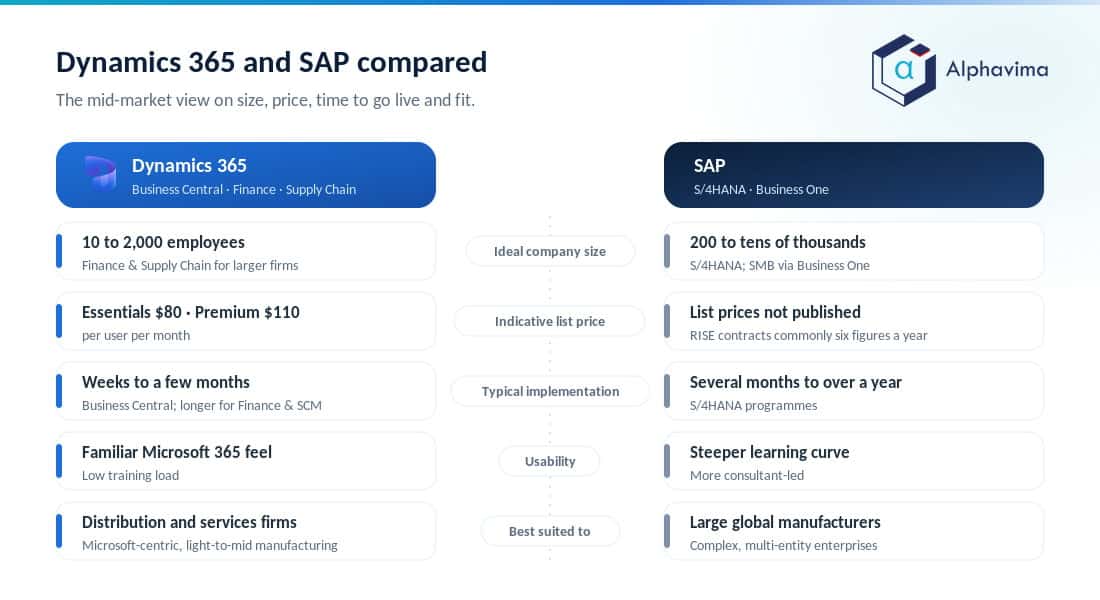
At a glance: Dynamics 365 vs SAP
| Factor | Microsoft Dynamics 365 | SAP |
|---|---|---|
| Core mid-market products | Business Central (SMB/mid); Finance & Supply Chain (larger) | Business One (SMB); S/4HANA (mid to enterprise) |
| Best for | Microsoft-centric firms, distribution, services, light-to-mid manufacturing | Large, complex, global manufacturers and multi-entity enterprises |
| Ideal company size | ~10 to 2,000 employees | midsize upward, into the tens of thousands (S/4HANA); SMB via Business One |
| Pricing model | Named-user subscription, published per-user list prices | Subscription (RISE/GROW) by Full Use Equivalent users; per-user list prices not published |
| Indicative list price | BC Essentials $80, Premium $110/user/mo; D365 Finance from $210/user/mo | Not published; third-party estimates put mid-market RISE contracts at six figures/year |
| Typical implementation | Weeks to a few months (BC); several months (Finance & SCM) | Several months to over a year for S/4HANA programmes |
| Usability | Familiar Microsoft 365 / Office feel, low training load | Powerful but steeper learning curve; more consultant-led |
| Ecosystem strength | Microsoft 365, Teams, Power Platform, Azure, Copilot | Deep manufacturing, supply chain, global compliance heritage |
| Cloud strategy | Cloud-first SaaS, continuous updates | RISE/GROW with SAP; ECC support ending drives S/4HANA moves |
| Main limitation | Very deep, industry-specific enterprise processes can need extension | Cost, complexity and time; heavier for smaller teams |
Prices above are indicative and were checked against the official Microsoft pricing pages in 2026; always confirm current figures before you budget.
Target size and complexity
Fit starts with honest self-assessment about size and process complexity.
Business Central is comfortable for organisations from around ten users up to a few hundred, and up into the low thousands with good design. It suits distribution, professional services, non-profits, and manufacturers whose processes are standard rather than exotic.
If your finance and operations can run on well-configured standard functionality plus a handful of add-ons, it is often the shortest path.
S/4HANA is built for scale and complexity: many legal entities, dozens of currencies, intricate production and planning, and demanding global tax and statutory requirements. If you are a 5,000-person manufacturer running plants across several countries, SAP’s depth is a genuine advantage.
The honest middle ground is the upper mid-market, where Dynamics 365 Finance and Supply Chain competes directly with S/4HANA, and the decision comes down to the factors below rather than raw capability.
Total cost of ownership and implementation time
This is where the two diverge most sharply, and where mid-market budgets are won or lost.
Microsoft publishes list prices, which makes budgeting easier. Business Central Essentials is $80 per user per month and Premium is $110, with Team Members at $8 for light users, according to the official Business Central pricing page.
At the larger end, Dynamics 365 Finance starts at $210 per user per month. We break the Microsoft licensing down further in our Business Central pricing guide.
SAP publishes packaging for its cloud ERP but not public per-user list prices for S/4HANA or RISE with SAP. Subscriptions are priced by Full Use Equivalent (FUE) user counts plus platform consumption and services, and third-party analysis puts mid-market RISE contracts in the six figures per year before implementation.
That opacity is not necessarily worse value, but it does mean more negotiation and less certainty up front.
Implementation is the bigger cost story. A Business Central rollout can go live in weeks to a few months for a focused scope. An S/4HANA programme, by contrast, is usually measured in many months to well over a year, with correspondingly larger consulting fees.
SAP’s depth is real, but so is the time and money required to configure it. For a mid-market firm, that gap in time-to-value is often the deciding factor.
Tip: Compare five-year total cost of ownership, not month-one licence cost. Include implementation, integration, change management, internal effort and annual support, then weigh that against the value each platform actually delivers for your processes.
Usability and the Microsoft 365 ecosystem
Software only pays back when people use it well, and this is Dynamics 365’s clearest advantage.
Business Central and the wider Dynamics 365 range share the look and behaviour of Microsoft 365. Users move between Outlook, Excel, Teams and the ERP without a jarring context switch, and finance teams can edit data in Excel and publish it back.
That familiarity lowers training time and boosts adoption, which is often where ERP projects quietly succeed or fail. Native ties to Teams, the Power Platform for low-code apps and automation, Azure, and Microsoft’s Copilot AI assistants add real day-to-day value for organisations already invested in Microsoft.
SAP is powerful, and its Fiori interface has improved considerably, but it remains more consultant-led and carries a steeper learning curve. In large enterprises with dedicated SAP teams that is manageable and expected.
In a lean mid-market finance department, the training and change-management load is heavier. If your staff live in Microsoft 365 all day, Dynamics 365 will feel like home in a way SAP does not.
Customisation and the partner ecosystem
Both platforms are highly extensible, with large global partner networks, but the extension models differ.
Dynamics 365 uses AL extensions and a broad AppSource marketplace, so customisations sit alongside the core rather than modifying it, which keeps the continuous cloud updates from breaking your changes. The Power Platform lets business users build apps, portals and automations with relatively little code.
For most mid-market requirements, this combination is quick and cost-effective.
SAP’s ecosystem is deeper for complex, industry-specific processes, and its Business Technology Platform (BTP) provides serious extension, integration and analytics capability. SAP also promotes a “clean core” approach, keeping custom logic outside the digital core.
The trade-off is that this depth usually needs specialised SAP skills, which are scarcer and more expensive than Microsoft skills in most markets. If you need a rare, highly bespoke process, SAP can likely do it; expect to pay for the expertise.
Industry depth and SAP’s manufacturing heritage
Credit where it is due: SAP earned its reputation in manufacturing and complex supply chains, and it still leads there.
For discrete and process manufacturers with sophisticated production planning, quality management, plant maintenance and global logistics, S/4HANA offers depth that is hard to match, backed by decades of industry-specific functionality and reference customers in automotive, chemicals, pharma and heavy industry.
If your competitive edge depends on that kind of process sophistication at scale, SAP deserves a serious look.
Dynamics 365 has closed much of the gap, particularly with Supply Chain Management for warehousing, production and asset management, and Business Central handles light-to-mid manufacturing well. For a large multinational manufacturer with deeply engineered processes, though, SAP is often still the safer technical choice.
For distribution, services, retail and mid-market manufacturing, Dynamics 365 is usually more than sufficient and quicker to deliver.
Stuck between a Dynamics 365 and an SAP quote?
Send us both proposals and a short note on your entities, plants and reporting obligations. We will score them against your actual requirements and show you where each platform costs you time, money or capability.
Cloud strategy in 2026
Both vendors are cloud-first, but they arrived by different routes, and that shapes your risk.
Microsoft built Dynamics 365 as cloud SaaS with continuous, automatic updates, so you stay current without disruptive upgrades, and Business Central, Finance and Supply Chain all run this way. The documentation on Microsoft Learn reflects a steady cadence of releases. For a mid-market buyer, this means predictable evolution and less upgrade pain.
SAP’s cloud journey is more of a migration. A large installed base still runs the older ECC system, and SAP’s mainstream maintenance for it ends in 2027 (with optional paid extended maintenance to the end of 2030), which is pushing many customers toward S/4HANA via RISE with SAP or GROW with SAP.
RISE bundles S/4HANA Cloud, BTP, SAP Business Network, Signavio process tools and migration support under one contract. It is a credible modern platform, but if you are new to SAP you are joining a large migration wave, so plan capacity and timelines accordingly.
If you are weighing the opposite move, our guide to SAP to Business Central migration sets out what that project involves.
Which should you choose? A decision guide
Set the marketing aside and answer a few questions honestly.
- Are you already a Microsoft 365 organisation? If Outlook, Teams, Excel and Azure are your daily tools, Dynamics 365’s ecosystem fit and lower training load are hard to beat.
- How complex is your manufacturing and global footprint? Many entities, currencies and deeply engineered production at large scale point toward SAP S/4HANA. Standard processes point toward Dynamics 365.
- What is your appetite for time and cost? If you need value in months on a predictable budget, Business Central or Dynamics 365 Finance usually wins. If you can fund a longer enterprise programme for maximum depth, SAP is viable.
- What skills can you access? Microsoft talent is generally more plentiful and affordable; specialised SAP skills cost more.
- Are you SMB? At the smaller end, compare Business Central with SAP Business One directly. Our Business Central vs SAP Business One guide covers that fight in detail.
For most mid-market, Microsoft-centric firms, Dynamics 365 is the pragmatic choice: faster to deploy, easier to adopt, cheaper to run and transparent on price. SAP earns its place when the requirement is genuine enterprise-grade complexity at global scale.
Both are excellent platforms; the right answer depends on your size, processes and priorities. An independent assessment through Alphavima’s ERP consulting practice can map your requirements against both before you commit.
Conclusion
Dynamics 365 and SAP are both capable, credible ERP platforms, and the honest answer to “which is better” is that it depends on your size, complexity and existing technology. Dynamics 365 tends to win for mid-market, Microsoft-centric firms that value speed, usability, transparent pricing and a familiar interface.
SAP tends to win for very large or complex global manufacturers that need maximum industry depth and can fund a longer, heavier programme.
The best next step is an independent assessment that maps your real requirements, budget and timeline against both platforms, rather than a demo tuned to a vendor’s strengths. That is how you avoid buying more ERP than you need, or less than your growth demands.
Ready to move forward? Talk to the Alphavima team about your ERP shortlist and let our ERP consulting specialists give you a straight, requirements-led recommendation, Microsoft, SAP or otherwise.

Related case study
Manufacturing ERP on Business Central
A manufacturer put the shop floor, stockroom and finance on one Dynamics 365 Business Central ERP.
Read the case study · Next read: The 12-question ERP selection checklist
Frequently asked questions
Is Dynamics 365 cheaper than SAP?
Dynamics 365 usually has a lower total cost of ownership for mid-market firms, thanks to published per-user pricing, faster implementation and lower training costs. SAP does not publish public per-user list prices, and S/4HANA programmes tend to run longer and cost more to deploy, though value depends on the depth you actually need.
Which is better for a mid-market company, Dynamics 365 or SAP?
For most mid-market organisations, especially those already using Microsoft 365, Dynamics 365 (Business Central or Finance and Supply Chain) is the more practical fit because of quicker deployment, easier adoption and predictable pricing. SAP is the stronger choice for very large or highly complex global manufacturers.
What is the difference between Business Central and S/4HANA?
Business Central is Microsoft’s ERP for small and mid-sized businesses, covering finance and operations in one application with fast deployment. S/4HANA is SAP’s enterprise-grade flagship for larger, more complex organisations, offering deeper industry and manufacturing functionality but requiring a bigger implementation.
Is SAP better than Microsoft for manufacturing?
For large-scale, complex discrete and process manufacturing with sophisticated planning and global logistics, SAP S/4HANA generally offers deeper functionality. For light-to-mid manufacturing and distribution, Dynamics 365 Supply Chain Management and Business Central are usually more than sufficient and faster to implement.
How long does a Dynamics 365 vs SAP implementation take?
A focused Business Central rollout can go live in weeks to a few months, while Dynamics 365 Finance and Supply Chain typically take several months. SAP S/4HANA programmes are usually measured in many months to over a year, depending on scope and complexity.
What is RISE with SAP?
RISE with SAP is SAP’s subscription package that guides customers onto S/4HANA Cloud. It bundles the ERP, SAP Business Technology Platform, SAP Business Network, Signavio process tools and migration support under one contract, and is priced by Full Use Equivalent users rather than published list rates.
Is SAP Business ByDesign still available?
Not for new customers. SAP removed Business ByDesign from its price list in April 2026. Existing customers keep their contracts and maintenance, and SAP has not announced an end date for that support. SMB customers are directed toward S/4HANA Public Cloud (GROW with SAP), so ByDesign should not be on a new shortlist.
Can Dynamics 365 integrate with Microsoft 365 and Power BI?
Yes. Dynamics 365 is built to work natively with Microsoft 365, Teams, Excel, Power BI and the Power Platform, plus Copilot AI features. This tight integration is one of its main advantages over SAP for organisations already standardised on Microsoft.