











Choosing an ERP is one of the most expensive and long-lived decisions a business makes. The system you pick in 2026 will likely still be running your finance, inventory and operations in 2033, and the cost of getting it wrong is measured in years, not quarters.
Yet most selection processes are driven by demos, brand names and whoever gives the best lunch, rather than a structured set of questions.
This ERP selection checklist is written for the finance leader, operations director or IT buyer who wants a repeatable way to compare options without the sales theatre. It gives you twelve questions to put to every vendor on your shortlist, explains why each one matters and what a good answer looks like, and ends with a scoring table you can copy into a spreadsheet.
The framework is deliberately vendor-neutral; it works for any product you are weighing.
Key takeaway / What you’ll learn: A structured, twelve-question framework for evaluating any ERP, why each question matters, what a strong answer looks like, and a copyable scoring table so your shortlist is compared on evidence rather than sales polish.
Table of contents
Why a checklist beats a demo
ERP projects fail quietly and expensively, and the root cause is usually decided before implementation even starts. Gartner predicts that by 2027, more than 70% of recently implemented ERP initiatives will fail to fully meet their original business goals.
Most of that shortfall is decided at the selection stage rather than in delivery. The firm’s wider coverage of enterprise resource planning is a useful primer, and in our experience the organisations that struggle tend to be the ones that underspecified requirements up front. We unpack those failure patterns in detail in why ERP implementations fail, and almost every one of them is visible during selection if you ask the right question.
A demo shows you a happy path the vendor has rehearsed. A checklist forces the awkward questions (cost, migration, compliance, roadmap) to the surface while you still have negotiating power, and the differences that matter stop hiding behind the user interface.
The 12 questions
1. Process and requirements fit
Why it matters: An ERP that does not match how you work forces you into one of two bad outcomes: expensive customisation, or bending your process to the software. Both cost money and goodwill.
What a good answer looks like: The vendor demonstrates your top ten to fifteen core processes (order to cash, procure to pay, your specific inventory or manufacturing flow) in the standard product with minimal configuration.
Ask them to run your scenario, not their scripted one. As a working rule, we look for around 80% or more of requirements met out of the box, with the gap closed by configuration rather than custom code.
2. Total cost of ownership
Why it matters: The licence price is the visible tip. True total cost of ownership (TCO) over five years includes implementation, data migration, integrations, training, support, add-on modules and internal time. Many failed business cases were built on the subscription figure alone.
What a good answer looks like: The vendor gives you a five-year model naming implementation cost, annual subscription, expected add-ons and support. For a sense of how per-user subscription pricing works in practice, our Business Central pricing guide walks through the licence layer.
A good vendor will not flinch when you ask what the price excludes.
3. Deployment model
Why it matters: Cloud (SaaS), on-premises and hybrid each carry different cost profiles, upgrade obligations, security responsibilities and cash-flow implications. The wrong model creates friction for a decade.
What a good answer looks like: The vendor is honest about the trade-offs rather than pushing one model. Cloud SaaS means predictable subscription cost and automatic updates but ongoing fees and less control; on-premises means capital cost and self-managed upgrades but full control.
A good answer matches the model to your IT capacity and regulatory position, and confirms the upgrade cadence in writing.
4. Scalability and headroom
Why it matters: You are buying for where the business will be in five years, not today. An ERP comfortable at your current volume and entity structure can become a bottleneck after growth or acquisition.
What a good answer looks like: The vendor cites customers several times your size on the same product and explains how multi-company, multi-currency and multi-country structures are handled. Ask what happens when you double your users or add a second legal entity, and whether that triggers a more expensive tier.
If you are starting small, our guide to the best ERP for small business shows where the entry-level products run out of room.
5. Integration and openness
Why it matters: An ERP never runs alone. It exchanges data with your CRM, e-commerce, warehouse, payroll, banking and reporting tools, and a closed system turns every connection into a custom project.
What a good answer looks like: Documented, modern APIs (REST/OData), a supported integration platform, and named pre-built connectors for the systems you already run. “We can integrate with anything” is a warning sign; “here is our published API and three connectors you would use” is a good answer.
6. Industry and vertical fit
Why it matters: A generic ERP configured from scratch for a specialised industry (manufacturing, distribution, professional services, non-profit) is slower and riskier than one with relevant capability already built in.
What a good answer looks like: The vendor offers, or partners for, functionality that speaks your industry’s language: lot and serial tracking, project accounting, field service, or fund accounting as appropriate. Partner-built industry accelerators can close much of the gap, packaging the vertical requirements rather than building them line by line.
7. Reporting and business intelligence
Why it matters: An ERP that captures data but cannot report on it easily pushes everyone back into spreadsheets, which defeats the point. Poor reporting is one of the most common post-go-live complaints.
What a good answer looks like: Native dashboards, self-service report building for finance users, and a clean path into a proper BI tool. Ask how a non-technical controller builds a new report, and how data reaches your analytics platform without a fragile export routine.
8. User adoption and usability
Why it matters: Adoption is where value is won or lost. A powerful system people avoid delivers none of the benefits in the business case, and resistance to change is one of the most common reasons we see go-live dates slip.
What a good answer looks like: A clean interface, role-based screens, mobile access and embedded help. Put an actual end user (a warehouse clerk, an AP processor) in front of the software during evaluation and watch how quickly they complete a common task.
Their reaction predicts your adoption curve better than any feature list.
9. Implementation partner quality
Why it matters: The partner delivering the project often matters more than the software brand. The same product can succeed with a strong partner and struggle with a weak one.
What a good answer looks like: References in your industry and at your size, a named delivery team (not just a sales team), a clear methodology, and a plan for governance and change management.
Ask who specifically will run your project and to speak to two customers they delivered in the last year.
10. Data migration
Why it matters: Migrating master data and history from your legacy system is one of the most underestimated parts of any ERP project. Dirty, duplicated or poorly mapped data undermines the new system from day one.
What a good answer looks like: A defined methodology covering extraction, cleansing, mapping, validation and reconciliation, plus a clear position on how much transaction history moves across. Strong teams treat this as an engineering discipline; our data engineering services exist precisely because migration is where projects quietly go wrong.
Beware any answer that treats it as a checkbox.
11. Security and compliance
Why it matters: Your ERP holds financial, customer and often personal data. A gap in security or compliance is a legal and reputational exposure, and in regulated sectors it can block go-live entirely.
What a good answer looks like: Documented certifications (for example ISO 27001, SOC reports), role-based access control, encryption in transit and at rest, audit trails, and clear data-residency options. Ask where your data physically lives and how the vendor supports your obligations (GDPR, industry regulation, financial audit).
12. Product roadmap and vendor viability
Why it matters: You are entering a relationship that should last a decade. A vendor that is losing investment, being acquired, or letting a product stagnate is a risk regardless of how the software looks today.
What a good answer looks like: A public, credible roadmap, regular release cadence, healthy financials or backing, and evidence of ongoing investment in areas such as AI and analytics. A good vendor can tell you what shipped in the last two releases and what is coming in the next two.
Tip: Weight the twelve questions before you score anyone. Not every criterion matters equally to every business. A regulated financial-services firm may weight security and compliance heavily; a fast-growing distributor may weight scalability and integration.
Agree the weights with your stakeholders first, so the final number reflects your priorities and not just a raw average.
The scoring table (copy this)
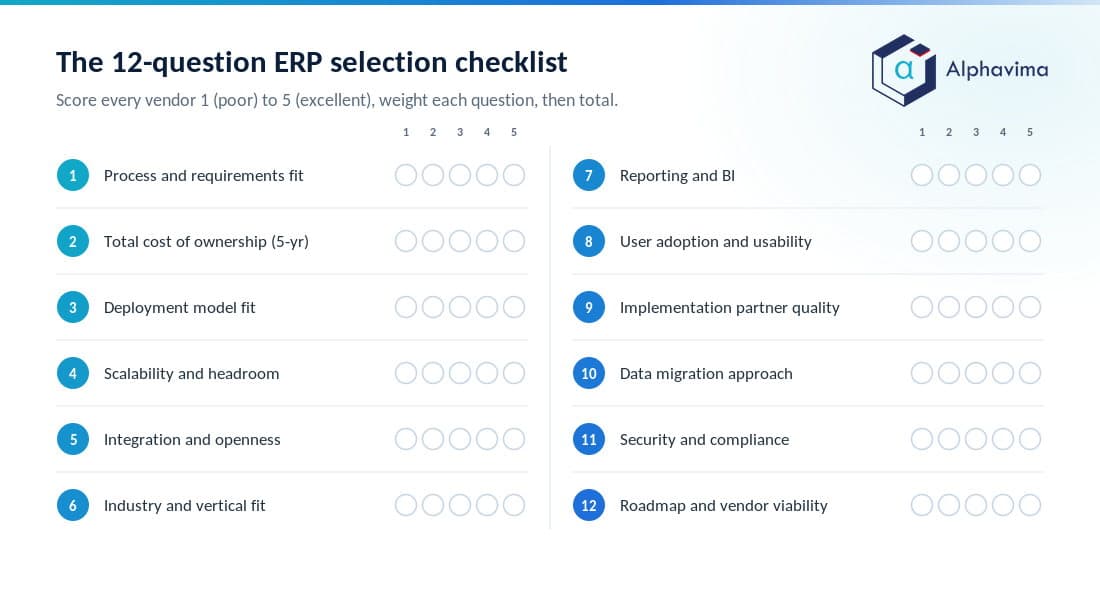
Score each vendor 1 to 5 on every question (1 = poor, 5 = excellent), multiply by the weight you have agreed, and total the weighted scores. The vendor with the highest weighted total is your evidence-based front-runner. Copy the structure below into a spreadsheet and add a column per shortlisted vendor.
| # | Selection question | Weight (1-5) | Vendor A (1-5) | Vendor B (1-5) | Vendor C (1-5) |
|---|---|---|---|---|---|
| 1 | Process and requirements fit | ||||
| 2 | Total cost of ownership (5-yr) | ||||
| 3 | Deployment model fit | ||||
| 4 | Scalability and headroom | ||||
| 5 | Integration and openness | ||||
| 6 | Industry and vertical fit | ||||
| 7 | Reporting and BI | ||||
| 8 | User adoption and usability | ||||
| 9 | Implementation partner quality | ||||
| 10 | Data migration approach | ||||
| 11 | Security and compliance | ||||
| 12 | Roadmap and vendor viability | ||||
| Weighted total |
Note: A score is a conversation starter, not a verdict. If two vendors land within a few points of each other, the tie-breaker is usually the implementation partner and the cultural fit of the delivery team, not the software. Use the number to narrow, then dig into the top two.
A short real-world scenario
Consider a 120-person distribution business replacing an ageing on-premises accounting system. Their instinct was to pick the product with the flashiest warehouse-management demo. Running the twelve-question checklist changed the outcome. The flashy option scored well on usability and reporting but poorly on total cost of ownership (its warehouse module was a paid add-on) and integration (no connector to their e-commerce platform).
A quieter competitor scored lower on the demo but far higher on TCO, integration and partner quality.
The weighted table made the trade-off explicit rather than emotional. Because the business had weighted integration and cost heavily, the second product won on the numbers, and the decision survived board scrutiny because it was defensible.
That is the value of a checklist: it turns a subjective preference into a documented decision your stakeholders can trust.
Shortlist down to two and still not sure?
Send us your shortlist and the answers each vendor gave, and we will score them against the twelve questions with you and model the real five-year cost. You end up with a decision your board can read in one page.
Warning signs to watch for
- The vendor will only demo their own script and resists running your scenarios.
- Every gap is answered with “we can customise that” rather than a standard capability.
- The quote covers licences but stays vague on implementation, migration and support.
- You cannot get two reference customers of your size and industry.
- The roadmap is a marketing slide with no dates or recent releases.
- Data migration is described as simple or is barely mentioned.
Any one of these on its own is a yellow flag. Two or more together should push that vendor down your list regardless of how good the software looks.
How Alphavima helps you evaluate
The checklist above is deliberately vendor-neutral, and you should run it that way. Where Alphavima adds value is in the evaluation itself: as a Microsoft partner, our ERP consulting practice helps buyers score their shortlist honestly, model real five-year total cost of ownership, and pressure-test each vendor’s answers to the twelve questions.
For organisations that reach the Microsoft end of the shortlist, we implement Dynamics 365 Business Central and the wider Dynamics 365 family, and we are candid about where they fit well and where another product might suit you better.
A fair evaluation is the one that leads to a system your people actually adopt.
Conclusion
An ERP decision is too consequential to leave to demos and brand recognition. Twelve consistent questions, weighted to your priorities and scored on evidence, turn a high-stakes gamble into a defensible business decision.
Run every vendor through the same framework, insist on your own scenarios and real references, and model the full five-year cost rather than the sticker price.
Copy the scoring table, agree your weights with the people who will live with the system, and use it in every evaluation meeting. The vendor that wins on the numbers, and whose delivery team you trust, is the one to shortlist for contract.
Ready to move forward? Talk to the Alphavima team about running this checklist against your shortlist. Our ERP consulting practice will help you score vendors honestly, model real total cost of ownership, and reach a decision your board can stand behind.
Frequently asked questions
What is an ERP selection checklist?
An ERP selection checklist is a structured set of questions used to compare ERP vendors on the same criteria, such as process fit, cost, deployment, integration, security and roadmap. It replaces demo-driven, subjective decisions with a documented, weighted comparison that stakeholders can trust.
How do you choose the right ERP system?
Define your core requirements first, build a shortlist, then score each vendor against a consistent set of questions using agreed weights. Run your own process scenarios in demos, insist on reference customers of your size, and model five-year total cost of ownership rather than deciding on subscription price alone.
What are the most important ERP selection criteria in 2026?
Process and requirements fit, total cost of ownership, integration openness, data migration approach, security and compliance, and vendor roadmap consistently matter most. Their relative weight depends on your business; a regulated firm weights compliance heavily, a growing one weights scalability and integration.
How many ERP vendors should be on a shortlist?
Three to five is a practical range. Fewer than three gives you little to compare, and more than five stretches your evaluation team thin and makes demos hard to keep consistent. Use the twelve-question checklist to narrow a long list down to this shortlist.
Why do so many ERP implementations go over budget?
In our experience it is rarely the software licence. Overruns nearly always trace back to work that was never scoped at selection: additional technology the business case did not allow for, data cleansing that took far longer than assumed, and change management that was never properly funded. Weak requirements at the selection stage are the common root.
Should I choose cloud or on-premises ERP?
Cloud SaaS suits most organisations that want predictable subscription cost and automatic updates without managing infrastructure. On-premises suits those needing full control or facing specific data-residency constraints. Match the deployment model to your IT capacity, regulatory position and cash-flow preference rather than to fashion.
How important is the implementation partner?
Very. The same ERP product can succeed with a strong partner and struggle with a weak one, so partner quality often matters more than the software brand. Assess methodology, industry references, the named delivery team and change-management approach, not just the sales relationship.
How do you score ERP vendors objectively?
Agree a weight for each selection criterion with your stakeholders, then score every vendor 1 to 5 on each question, multiply by the weight, and total the results. The weighted total narrows the field to a top two, after which partner fit and delivery-team quality usually decide the winner.